Sunday, February 7, 2010

Shopping for Pomegranates at Wal-Mart with poet Campbell McGrath

It's Super Bowl Sunday. What better day for a little poetry rant?

I went to see Woody Guthrie's American Song two times within 24 hours, in part because I had been in a somewhat saddened-and-smoldering mood for too long, something like the one described below by poet Campbell McGrath. This was published in The New Yorker on January 11, 2010. It reminds me of my dad describing the Mall of America (one of his least favorite places), or the feeling of appalled-and-dulled alarm that comes when flipping through (at least) Fifty-Seven-Channels-and-Nothing's-On. It's not nothing: nothing would be a relief. Instead, we are material witnesses (or, to put it anthropologically, "participant-observers") of the chaos of late high capitalism, as described in the frenzied poem below.

Woody Guthrie's American Song, like Garrison Keillor's  A Prairie Home Companion the night before, restored my soul to a temporary sense of peace, not least because both involved real people engaged in creating something, paying attention to something, organizing and coordinating their efforts in order to make a dent in the direction of giving the world something immediate, meaningful, valuable, and deliberate. It just felt so much better than randomly sitting in front of the tv (for example), the way it feels to me to shop at the farmers' market or the food co-op, instead of at a place like Wal-Mart. (I do realize that I am setting up a good/bad opposition here; can't be helped, I'm afraid.)

I see a mythological subtext to this poem. Persephone, the daughter of Demeter (Earth-mother who presided over grains, fertility, the harvest and the seasons in classical Greek mythology) was spirited away to the Underworld (like Alice?), where she was tricked by Hades into eating pomegranate seeds. It was a rule of the Fates that whoever consumed food or drink in the Underworld was doomed to spend eternity there. This sounds like a trip to hell, too. Here is McGrath with a plastic orange rather than a pomegranate.

Shopping for Pomegranates at Wal-Mart on New Year’s Day

Beneath a ten-foot-tall apparition of Frosty the Snowman
with his corncob pipe and jovial, over-eager, button-black eyes,
holding, in my palm, the leathery, wine-colored purse
of a pomegranate, I realize, yet again, that America is a country
about which I understand everything and nothing at all,
that this is life, this ungovernable air
in which the trees rearrange their branches, season after season,
never certain which configuration will bear the optimal yield
of sunlight and water, the enabling balm of nutrients,
that so, too, do Wal-Mart’s ferocious sales managers
relentlessly analyze their end-cap placement, product mix,
and shopper demographics, that this is the culture
in all its earnestness and absurdity, that it never rests,
that each day is an eternity and every night is New Year’s Eve,
a cavalcade of B-list has-beens entirely unknown to me,
needy comedians and country singers in handsome Stetsons,
sitcom stars of every social trope and ethnic denomination,
pugilists and oligarchs, femmes fatales and anointed virgins
throat-slit in offering to the cannibal throng of Times Square.
Who are these people? I grow old. I lie unsleeping
as confetti falls, ash-girdled, robed in sweat and melancholy,
click-shifting from QVC to reality TV, strings of commercials
for breath freshener, debt reconsolidation, a new car
lacking any whisper of style or grace, like a final fetid gasp
from the lips of a dying Henry Ford, potato-faced actors
impersonating real people with real opinions
offered forth with idiot grins in the yellow, herniated studio light,
actual human beings, actual souls bought too cheaply.
That it never ends, O Lord, that it never ends!
That it is relentless, remorseless, and it is on right now.
That one sees it and sees it but sometimes it sees you, too,
cowering in a corner, transfixed by the crawler for the storm alert,
home videos of faces left dazed by the twister, the car bomb,
the war always beginning or already begun, always
the special report, the inside scoop, the hidden camera
revealing the mechanical lives of the sad, inarticulate people
we have come to know as “celebrities.”
Who assigns such value, who chose these craven avatars
if not the miraculous hand of the marketplace,
whose torn cuticles and gaudily painted fingernails resemble nothing
so much as our own? Where does the oracle reveal our truths
more vividly than upon that pixillated spirit glass
unless it is here, in this tabernacle of homely merchandise,
a Copernican model of a money-driven universe
revolving around its golden omphalos, each of us summed
and subtotalled, integers in an equation of need and consumption,
desire and consummation, because Hollywood had it right all along,
the years are a montage of calendar pages and autumn leaves,
sheet music for a nostalgic symphony of which our lives comprise
but single trumpet blasts, single notes in the hullabaloo,
or even less—we are but motes of dust in that atmosphere
shaken by the vibrations of time’s imperious crescendo.
That it never ends, O Lord. That it goes on,
without pause or cessation, without pity or remorse.
That we have willed it into existence, dreamed it into being.
That it is our divine monster, our factotum, our scourge.
That I can imagine nothing more beautiful
than to propitiate such a god upon the seeds of my own heart.

Saturday, February 6, 2010

Woody Guthrie's American Song


This month marks the 70th anniversary of Woody Guthrie's iconic "This Land Is Your Land," written in 1940. At the Unitarian Universalist Church here in Bloomington, Indiana, the Heartland Players are presenting their version of Peter Glazer's "Woody Guthrie's American Song," a fundraiser for Mother Hubbard's Cupboard Food Pantry and Mental Health America of Monroe County. Directed by Steve Krahnke (of public television WTIU), with musical direction by Dan Lodge-Rigal, this is a spectacular production.

The extraordinary talent on stage includes the Breeden brothers, Darrell and Bill (Darrell plays the oldest Woody); members of the Jesseph family, Laura, Maggie and Charlie (Charlie, as the youngest Woody, sings a heartbreaking version of "Dust Storm Disaster"); and featured singers Jane McLeod, Mitch Rice, Mary Boutain, Guy Loftman, Laura Wanner and Licia Weber. The performance has energy from the first number, "Hard Travelin'/The People I Owe" to the last, "This Land is Your Land."

There's a PBS American Masters show about Woody Guthrie called "Ain't Got No Home" that tells the often tragic story of his life, including his death at age 55 of complications from Huntington's Disease. This show focuses more on the enduring relevance of Guthrie's contribution to folk music, and the ways in which he remains "at home" everywhere common people gather, suffer, and seek economic justice.

Maggie Jesseph put it this way:

"Woody Guthrie's American Song"...makes me laugh and cry, feel weak and small and then big and powerful--I guess that is how it is when you are telling the people's story.


Charlie Jesseph posted a video to YouTube that gives you a hint, in rehearsal, of this wonderful tribute to Woody Guthrie.


Friday, February 5, 2010

A Prairie Home Companion at the movie theater


We saw the Live Cinecast version of Garrison Keillor's A Prairie Home Companion last night at our local movie theater, with guests Heather Masse, Elvis Costello, and Jearlynn and Jevetta Steele. It was a quiet, somewhat melancholy show, I thought, especially compared with the live version we saw here at the IU Auditorium a couple of years ago (on February 16th, 2008), when the focus was on extraordinarily talented musicians at the Jacobs School of Music. Garrison made a comment about those things that always seem to be just out of reach: "glamor, a Super Bowl victory, and health care reform." The somewhat somber mood seemed fitting for this particular moment in time, though, a welcome contrast to irrational exuberance and all forms of hyped up "reality" on so many screens.


It is fascinating to contemplate the coordination of the abundant artistry and talent on the set of A Prairie Home Companion. The timing and pacing are tight and graceful; the live show allows you to see the script falling on cue from Sue Scott's hands as she reads her lines; the sound effects guys seem like familiar friends; Rich Dworsky, at the piano, centers and smooths the activity around him.

I loved the duets Garrison sang with the radiant Heather Masse (of the Wailin' Jennys): "My Life" by Iris DeMent and "If You Were Mine" by Ann Reed. Elvis Costello sang some great original tunes. The Steele Sisters are always wonderful.

A pre-show tour with Garrison of downtown St. Paul, in the area around the Fitzgerald Theater, was a special treat for those of us who know the landmarks of that city, including Landmark Center, Mickey's Diner, and the Fitzgerald Theater. Garrison gently brushed the snow off the bronze life-sized statue of F. Scott Fitzgerald.

I've always felt connected to A Prairie Home Companion, in part because of Twin Cities musicians I've known who've appeared there over the years: Peter Ostroushko, Robin and Linda Williams (who were featured in this performance), Bill Hinkley and Judy Larson, Cal Hand, Mary DuShane, Rod and Katey Bellville. It's a religious experience for me, somehow, about the passage of time, a recurring theme in the Church of Garrison Keillor. He's a preacher of something I'm trying to put into words: a unique mixture of nostalgia, gentle ribaldry, common absurdity, and a fierce politics in defense of some kind of democracy that seems ever more elusive.

One of the highlights of the Live show we saw here in 2008 was singing the "Star Spangled Banner" together to warm our voices before the taping began. Keillor mentions the desire to do some of that audience singalong the next time they tape a film version.

If you go to this link, you'll find a fun cartoon by artist Chris Monroe of "Violet Days," called  "Prairie Home: A True Story." Sweet. She effectively captures the moody blues terror of the midnight writer: look how his hands are attacking that keyboard!

Thursday, February 4, 2010

These Are the Cities Marco Polo Left Behind


I was recently at the extraordinary Lilly Library, on the campus of Indiana University, for the opening of their Treasures exhibition, commemorating their fiftieth anniversary.

I saw Marco Polo's Buch des edelen Ritters und Landfahrers Marco Polo (Nuremberg, 1477), and one of my friends is suggesting that our book club investigate Marco Polo. It's another gap in my education, and would probably be fascinating on the heels of reading Charles Darwin (moving even further back in time, with the explorers). Here is a teaser about the book:
1298: Marco Polo was captured during a civil war between Venice and Genoa. During his imprisonment, he dictated a detailed account of his travels to a fellow prisoner. The resulting book (known alternately as “Il Milione,” “The Description of the World” or “The Travels of Marco Polo”) became a huge success in Europe, 200 years before the invention of the printing press.
It would also help me read more deeply into the poem here by Joyce Kennedy (my mother), once made into a beautifully illustrated letterpress-printed broadside by artist and printer Regula Russelle, also of the Laurel Poetry Collective in the Twin Cities (and one of my prized possessions).

       These Are the Cities Marco Polo Left Behind
– cities invisible on road of silk,
scattered into time, cities that dazzled
eye and mind, cities possessed
by passion for wealth, dense cities
of desire, and the lost cities of youth,
those of mirrors and illusion.

And not behind,
the one where we all live,
inferno of the living,
in welter of contradiction,
just city and unjust city
wrapped one within the other.

Crammed into time until the city pleads:

Learn who and what are not inferno,
then make them endure, give them space.

A just city for its children.

Visible, shining, on road of silk.

– Joyce Kennedy [all rights reserved]
              italics by Italo Calvino, Invisible Cities

Wednesday, February 3, 2010

In Praise of Obscurity, and Maureen's Twittered Cookbook

I found Maureen Evans in the current issue of Wired magazine, in a piece by Clive Thompson called "In Praise of Obscurity." It's not online yet, so I'll quote at length:
Consider the case of Maureen Evans. A grad student and poet, Evans got into Twitter at the very beginning – back in 2006 – and soon built up almost 100 followers. Like many users, she enjoyed the conversational nature of the medium. A follower would respond to one of her posts, other followers would chime in, and she'd respond back. Then in 2007 she began a nifty project: tweeting recipes, each condensed to 140 characters. She soon amassed 3000 followers, but her online life still felt like a small town: Among the regulars, people knew each other and enjoyed conversing. But as her audience grew and grew, eventually cracking 13,000, the sense of community evaporated. People stopped talking to each other and even to her. "It became dead silence," she marvels. 
Why? Because socializing doesn't scale. Once a group reaches a certain size, each participant begins to feel anonymous again, and the person they are following – who once seemed proximal, like a friend – now seems larger than life and remote. "They feel they can't possibly be the person who's going to make the useful contribution," Evans says. So the conversation stops...
The lesson? There's value in obscurity...Maybe we should be designing tools that reward obscurity– that encourage us to remain in the shadows.
It's interesting that Thompson chose Evans as his example: poets are already fairly accustomed to laboring in obscurity. (Lovers of obscurity, even – even when they have readers.) But the issue of social scale is interesting, whether we're talking about social media, wedding guests or a proliferation of "best friends forever." Are we talking? When do we talk anymore? What do conversations look like? Or feel like?

Here are more responses to Maureen's compressed cookbook, including one from by Lawrence Downes at the New York Times, who has dehydrated and tried some of the recipes, attesting to their viability.

Some examples from twitter feed cookbook (18,611 followers, 352 tweets):
Cheese Bread: mix 3c flr/T bkgpdr/~¼t cayenne&pep/c dice cheddar; fold+mixd 2c buttrmilk/btn egg/3T oil. Fill pan; top w parm. h@350°F/175℃

Winter Fruit Salad: mix gr+rd apple&asianpear/T lem; toss w 2mandarin+tangerine/c date&kumquat/~3T GingerSyrup. Chill; dust w cinn. Ylds~8c. 
Almond Soup: simmr c grnd almond/3c Stock/whl onion/clove&bay 30m. Sieve; +½c milk/nutmeg&s+p. Brwn 2T buttr&flr; whisk+soup. Heat; +c crm.

Quick Orange Beets: Shred lb beet; +T butter/t mustard/¼c oj/s+p. Cvr5m@med to tender; uncvr to evaporate liquid.
Turnip Gratin: brwn onion/2T buttr; +c stock/¼c crm. Reduce to ½; s+p. Slice 2turnip&tater; lyr4x w sauce. Top w 2c breadcubes; h@375℉/190℃.
Choco Nut Cookies: cream 5T buttr&nutbuttr&sug; +egg/¼t vanil&salt. Mix+c flr/½t bkgpdr; +¼c choc chip. Form log,chill,cut20. 8m@400°F/200℃.
The latest message from Maureen's poetry twitter feed: It's just me and Jim Hughson, four in the morning, editing chicken. (I like it. I'm there. Too.)


Tuesday, February 2, 2010

Here's who's out there: Maureen Evans, living in a castle near Belfast


Here's who's out there: Maureen Evans, living in castle in the fog near Belfast. She's also sometimes at Spezzato – that's where I found the mossy trail above, and this bio:


Hello, I'm Maureen Evans. Spezzato is my electronic notebook. I'm a writer, poet and anarchist from the Canadian Northwest, but I haven't been home for years.
I'm currently an MA English (creative writing) candidate at Queen’s University of Belfast. I studied writing and cultural resistance at UBC, earning a BFA (Hons). My writing has since been published by Room of One's Own, Fugue, the Kearny Street Workshop, League of Canadian Poets, the Grist Mill, and other small Canadian and American journals.

I attempt to make contributions to my communities and to larger society, and the search for how to do that is part of my writing. I have most recently acted as editing tutor on three teen-written books at 826 Valencia, a non-profit writing center, and did transcription of oral history of Sudan for McSweeney's Press. 

I live by the ocean with my travel accomplice, Blaine Cook. We ultimately plan to homestead in British Columbia, where I'd like to foster anarchism as both a writer and teacher.


 Below is Maureen's bio on Twitter, along with some recent messages there:

I measure out my life in senryu: haiku of human foibles. Regarding existence as a writer, and the Occupational Hazards of Poets. 

This coffee tastes of peonies and the inner blades of fresh green grass.
I wanted to break something; fixed a turntable and broke the silence.
"Oh wad some power the giftie gie us To see oursel's as others!" -Robert Burns, né 25 Jan 1759.
Drank so much coffee that I'd be calmer if I'd been drinking live bees.
Friday. The writing gloves are off. So now, where are my whisky mittens?
Mud speckled yellow stockings. Soda water green with vervaine. And sun.
The edge of the storm is a vapour point; the edge of the sky is soaked.
"It's no business of yours, but I do like to waltz with a log driver." -Kate McGarrigle, 1946-2010.
Waves rear up to top the lamp posts; the ocean spray sails over our roof.
Croutons on a plate, I feel as absurd as you, croutons on a plate.
Mustard yolks of mud smudged eggs from Port Muck. Coffee tasting of old earth.
Hidden David F. Wallace in Mac's thesaurus! Utilize. Hairy.
Went for a walk in the storm. Sometimes you have to get cold to get warm.
Pendulous rain off window frames; viscous slathered glass; salt lick slobber.
Kittiwakes' perfect impasse with the wind. Snarls of wool, dulse and plastic.


Monday, February 1, 2010

February! St. Brigid's Day, and Happy Birthday to Deirdre


It's February! For some reason I'm excited. The sun has been shining the past three days, and it's the birthday of Deirdre Otis, mother of the Seven Sidekicks, whom I've known since before she was born.

Deirdre is doing a novena for St. Brigid of Kildare during the next ten days, as a way of observing the birthday they have in common, February 1st, Candlemas,  the traditional first day of spring in Ireland. (Imagine that, those of you now in the deep Midwest.) She says it is:

A gift of reflection and peace for myself:) St Brigid is my birthday saint and confirmation name, the traditions surrounding this saint are so beautiful.

The stories around Brigid have with both pagan and Christian overtones. Here's just a glimpse, from our friends slaving away in the name of information over at Wikipedia:
According to her biographers her parents were Dubhthach, a pagan chieftain of Leinster, and Brocca, a Christian Pict and slave who had been baptised by Saint Patrick. Some accounts of her life suggest that Brigid's mother was in fact from Lusitania, kidnapped by Irish pirates and brought to Ireland to work as a slave, in much the same way as Saint Patrick. Many stories also detail Brigid's and her mother's statuses as pieces of property belonging to Dubhthach, and the resulting impact on important parts of Brigid's life story.

Brigid was given the same name as one of the most powerful goddesses of the pagan religion which her father Dubhthach practiced. In that religion, Brigid was the goddess of healing, inspiration, craftsmanship and poetry, which the Irish considered the flame of knowledge.
Below is St. Brigid's cross, woven from rushes, as well as a sample of Aryan knitting in a St. Brigid pattern, from a blog called Fluff Buff: Slow Life in the Fast Lane, An Italian in L.A. Brigid is represented by braided threads and rushes, connecting strands between pagan and post-Patrick Ireland. 

I have vivid memories of Deirdre visiting me in Ireland when she was a child of about nine or ten, when we played one afternoon at an Adventure Park where kids could swing on ropes over a pond, ride on rafts without adult navigation, and do other quasi-dangerous things that would never be allowed at an amusement park in the U.S. She was brave and much amused. Thinking back, I realize that this was a real hint of her life to come – now she has seven daredevil children who would probably love that experience, too. Both Deirdre and her husband Sheff know that kids have got to move, to be adventurous, and to experience the sensory pleasures of getting dirty, wet, muddy, cold (and warm again) in the great outdoors. I hope they all have a fabulous day!


Sunday, January 31, 2010

Something to Make: More Covered Boxes

I'm a big fan of the French Paper company in Michigan, experts at making uncoated papers, and promoters of off-the-beaten-track design. Now they are offering gift wrap, too, along with other quirky Pop Ink gifts. I ordered some paper called T & Asia, and it came in a wonderful large triangular box that I will be saving – and perhaps covering – soon. In the meantime, I used one sheet to cover this box. I'm lusting after the multi-use paper packs, too

The smaller box is a slider, for holding stamps or something else semi-precious. The Whale is from a French Paper ad, as is the image of the French Paper factory on the T&A box.


Saturday, January 30, 2010

In Praise of Kevin Barry's 'Fjord of Killary'


There were so many things I liked about Kevin Barry's story, "Fjord of Killary," appearing in The New Yorker this week. It was the first I'd heard of Barry, so there was that: the pleasure of "finding a shiny two-pound coin in a pile of muck," as Elaine Chiew puts it in The Short Review. (Not that the rest of The New Yorker content was mucky: quite the contrary.)

This was the pleasure of discovering a contemporary Irish writer who has an ear for the idioms of the West of Ireland as they might be given out these post-Celtic Tiger days at an old country pub. The protagonist is the owner of the Water's Edge Hotel, a middle-aged poet suffering under the ludicrous indignities of a "long silence" while serving drinks in the lounge bar where he thought he'd find purpose and a voice. Instead, he's drowning.

There's a psychological turn near the end of the story that nicely follows the pitch-perfect scenarios leading to it, with wilder, increasingly desperate social moments, vivid participants, and a rising sea. An otter is eating the carrot soup, and a black-backed gull tearing the head off its mate. Nature seeps in everywhere, and it is not sentimental and lovely; it is pagan, corrosive, and wild. The tone is at times wildly hilarious, perfectly absurd, and absolutely believable: a masterful combination.

The story contains "language." It gives the clientele of the pub a crude and booze-tinged view of the body in words that could be transcribed from conversations I recall overhearing in Irish bars: "It's not," says one old man, "like I'm going to take a lep at the little bitch. My leppin' days are long fuckin' over." The beauty is in the complete context of that phrase, and in that "lep."

The speaker is someone named Caoimhin (Irish for Kevin), and because he's a writer, it is tempting to imagine this is a "true story," and that we could find Kevin Barry tending bar near Galway, suffering from his dashed hopes. That's a nice loop, too – this is a true story of a different kind, crafted from scraps of experience but decidedly not a memoir or confessional tale. In the end, a Caoimhin discovers something profound (and profoundly Irish): the rigors (or rigor mortis?) of acceptance. The final epiphany is an energizing version of Irish Zen, an active high-tides-be-damned acceptance of the tragic and the absurd. I loved the last sentence.

Tracking down the craic about Barry, I surfed through a few Irish reviews. Here is an interview, by Eimear Ryan, and another in The Limerick Leader, from the town where Barry once was a journalist. And another interview in The Short Review, where the topic is Barry's There Are Little Kingdoms, a collection of short stories published in 2007 that subsequently won the Rooney prize for Irish Literature. Another here at Cheebah by Eilis Ni Leathlobhair. They note the author's kinship to J.M. Synge and to Beckett, and to the self-deprecating humor of Flann O'Brien (Brian O'Nolan), also a master of the form.

There's another Kevin Barry, of course: an early Irish Republican who was executed by the British in 1920, celebrated in a ballad, and given a state funeral in 2001 with nine other "volunteers from the War of Independence" ("The Forgotten Ten"), all of whom were eventually moved from Mountjoy Prison to be re-interred in Dublin at Glasnevin Cemetery. That's quite a lot of history to have echo in your name.


Friday, January 29, 2010

Grow your Own Food: a poster by PJ Chmiel at Lost River Community Co-op

Just an image today, made from a photo of a poster by PJ Chmiel  (a vegan graphic designer) that I saw on a wall at Indiana's newest food co-op, Lost River Market and Deli (also known as Lost River Community Co-op) in Paoli, Indiana. I like the poster, and it's message, and went at it with a clone stamp, mostly to attack the flash flaws in the photo. (Is that a sheep standing in the top front yard, or the lonely family poodle? No, it's a man on a motorized lawn mower!)

I'm intrigued by the word permaculture there:

Permaculture is a design system for creating sustainable human environments. Anyone can do it! (But we still have a lot to learn.)


Thursday, January 28, 2010

Ways of Reading the Bible ghazal, by Marie Deer

Marie Deer wrote this ghazal while on a retreat with Women Writing for (a) Change Bloomington, at the White Violet Center for Eco-Justice at Saint-Mary-of-the-Woods College near Terre Haute, Indiana.

Turns out that her father was born in Terre Haute, although she herself had never been there. Instead, as a child, she lived in Congo, where her parents were Baptist missionaries. Marie eventually married a Persian German Jew; we have a mutual friend who (in his doggerel) refers to their two sons as "Congolese Persian Baptist Jews." I like the reminder that identity is recreated with each generation (often in unexpected hybrid ways). I think they might more accurately be called "Hoosier Congolese Persian German Baptist Secular Jews"  – but I might just be getting presumptuous here about other people's identities. (Indeed.)

Marie spent time during her childhood as a scribe for her father, Donald Deer, who was translating the Bible into a Congolese trade language, Kituba, and perhaps other African languages, too (see the comments to this post for more information). Every so often she listened to a favorite family LP of Alice in Wonderland on the phonograph, too. These are the kinds of childhood activities that form the ideal curriculum for an aspiring poet. Marie's father recently celebrated his 8oth birthday.

So, for your pleasure, another wonderful ghazal, along with an image of a hieroglyphic Bible. (Wish I had one of those.)


Ways of reading the Bible ghazal

Under the covers; at breakfast; out loud: so many ways of reading the Bible.
I look back on my childhood: a life full of days of reading the Bible.

In Strasbourg, high in the air in our newly walled-off living room,
I am a ten-year-old girl whose patience frays at reading the Bible.

On the overstuffed green vinyl chairs we inherited from the Danish consul
My family of four takes turns, sings, and prays while reading the Bible.

We are completely conscientious; no verse or naughtiness, no paradox
Or lineage gets skipped. These are the outlines my father obeys in reading the Bible.

After our family has read through the Bible at least twice all together, I take it
Upon myself to read it alone. I dawdle over Revelations in my forays into reading the Bible.

On the hostel bus I argue with the children of fundamentalists. It was inevitable.
In our family we believe that they cheat and skate through the maze of reading the Bible.

It is our daily bread, our morning routine that in that time seemed leisurely
Before catching a seven-ten bus. Just routine. No applause or bouquets for reading the Bible.

A book full of books. A volume of riddles, histories and transformations.
We both revered it more and held it less sacred than others who laze through reading the Bible.

I'm sorry my children have grown without a family reading routine. It wouldn't have hurt.
If I had it to do again, we would, as they nibble, kibbitz and graze while reading the Bible.

The Book of Ruth. The Book of Esther. Lamentations. Some favorites.
I thought it was daily life and not just a phase, this reading the Bible.

My family singing, reading, praying. My family each with a book. Taking turns reading.
This is Marie's ongoing lifetime memory slideshow that plays of reading the Bible.

Tuesday, January 26, 2010

God ghazal, by Marie Deer

My friend Marie works with words in many ways: as a writer of novels that no one yet reads (she is a big fan of NaNoWriMo: National Novel Writing Month, each November, and has participated in that for two or three years); as an editor of textbooks and other scholarly writing (she is fluent in several languages, with a linguistics degree from a certain university in New Haven that will today go unnamed); as a writing coach, coaxing those who need to slog through sometimes intimidating projects; as the keeper of a blog; and as a poet.

She is also a fiercely brilliant word gamer, a worthy opponent for anyone daring enough to take her on in Scrabble, Lexulous, Boggle, or other word games, both on-line and at the dining room table. (Serial Susan has been her gaming friend, and it is rumored that Marie has taken down a few noted professional deconstructionists in her day.) I can't do it, I'm hopeless at such things once the heat is on: I need my word games to be very slow and contemplative, as I am apt to go down a rabbit hole and forget that I'm trying to beat either the clock or anyone but myself.

Anyway, that is a long introduction to the piece of writing I am posting today. Marie recently went on a Women Writing for (a) Change Bloomington weekend writers' retreat, and she focused on a favorite form, the ghazal. She's been sharing some of her ghazals the past few days, and gave me permission to post. I think they are very remarkable. I'm happy to serve as her literary agent if there are any book publishers out there looking for a next great poet. (I am also happy to represent my mother, Joyce Kennedy, whose extraordinary manuscript of poems about Shakespeare's female characters, Will's Women, needs a publishing home.)

There is a pattern to the ghazal. Without cheating and reading about it, can you discern what it is?

God ghazal

God has a place, surely, somewhere to be, at least some little nook for God.
And God has a shape, pentagod or octagod or something, or how could I look for God?

In the spaces between us, that's my line, that's my God-is-love theory, so weirdly
I'm always careful of those growing and shrinking spaces, alert and on the hook for God.

God being every gender of course, he/she/they are multidomestic and omnieverywhere,
Mr. and Mrs. God I call them, sitting them down as I tie on my apron and cook for God.

Mr. and Mrs. I call them, serving them all kinds of healthy-as-sin organic wonderful
Goodies they've never seen and they marvel. I'm putting it all in a gaudily illustrated book for God.

For nobody else would I cook and clean and work like this. I've even learned new stuff.
You wouldn't believe the workshops and tutorials and classes I took for God.

Things get in the way, obviously. Kids, work, husband, parents, you-name-it. But sometimes
I just have to broom them all out of the way, get out my little schedule, and rebook for God.

Life gets knotted up. I lose my way. My shoulders and back are tight and I frown.
Life gets knotted up and I have to take it all and undo, unstitch, unhook for God.

People are running everywhere. Max far away, Michel in a book, Felix online.
I want to scoop them together and show them what I've done and say see, look, all that I undertook for God!

Mostly I need to sit in this corner, that corner, some corner somewhere where I can close my eyes.
Sit in a corner, say I am Marie, this continues true, no matter what I forsook for God.

Clearing the Mourning, Clearing the Morning

Awake to find a 2-hour delay at the schools, due to icy roads and a bit of new snow. I keep thinking of my nephew Andrew, with his father's cousin brother Aggrey, in the Trobriand Islands to "clear the immediate mourning" for grandmother Sarah. How is that done, I wonder? One more of many skills that Andrew has.

Clearing the mourning, clearing the morning.

As Sarah leaves this world, a new little life unfolds: that of her great-granddaughter Tyemani, born last December 18th in Port Moresby to Suzie and Andrew. Little sister to Thierry and Thealani. Here is Andrew with his youngest child, and other sweet family photos, including one with Grandmother Kathy.

Sometimes it's hard to be far-flung! We'd love to hold this little baby, too, as would her great grandparents in Minnesota. I'm sure Sarah would also have loved to cradle her youngest little great.

Thinking of Suzie in Port Moresby, too, waiting for Andrew's (and Thierry's) returns from their travels, and then listening, with the girls, to their stories. Safe journeys!


Sunday, January 24, 2010

Ripples of Influence from a Small Island Cluster


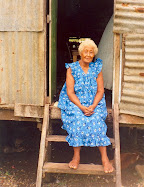
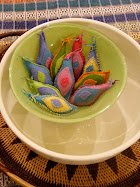
Here is a photo of Sarah Watson, my sister Kathy Lepani's mother-in-law. She is making a kind of currency or gift exchange used in sagali, memorial services for the departed. These bundles are made from scored banana leaves (also used for grass skirts) and are given in recognition of people who were important to the person who died. (Kathy, please chime in here to explain this more fully, if you wish.) I am sure there will be a lot of work to be done assembling these for Sarah's sagali, as she made so many for others during her lifetime. I like the fact that she has a little make-up bag in this photo...I wonder what she used it for? Look at the beautiful large woven basket, too. Sarah was a woman of regal bearing, wearing bare feet.

My parents wrote the words below. They once had the chance to visit Sarah's village in the Trobriand Islands. The bottom photo is of Sarah on the steps of her house, near her final resting place.

We have such vivid memories of Sarah--such a remarkable person--dignified, humorous, nurturing, generous, the center of her community.  We remember the hospitality she showed us when we visited her in Losuia, how she spread a tablecloth on the floor mat in her house, brought out her china and served us incredibly delicious meals of fish (or chicken), greens and yams. We remember her leadership and competence during a sagali we were privileged to witness. We remember her in the dark evenings sitting in her house, child in her lap, telling stories in Kiriwina, the circle of people around her listening and laughing.  On our trip by boat to Vakuta, we encountered a daunting storm;  Sarah held Genou, sea-sick, in her arms in the hold of the boat.  Holding a child is a recurring image of Sarah--it was repeated when Joyce visited her in Alitou with Kathy.

Burying Sarah in front of her house seems most fitting.  That was the center of her influence, the influence that rippled out into the world way beyond Losuia.

And my mother, Joyce Kennedy, also wrote a poem, about those ripples of influence.

January 21, 2010

Imagine a village woman who dies on this day.
In the morning she awakens as usual,
moves her old bones around her home
made partly of palm leaf;  by evening she is gone.
Put yourself into her past.
Become a child on her tropical island.
Place yourself in this woman’s arms.
The night is black, thick with stars.
Friends and relatives sit around her 
in the small space in which she lives.
She is telling stories. You listen half-asleep.  
You become part of the story, 
moving along in the soft rhythm of her words.
You know that you are safe within these words.  
How could you know that sometime in your future, 
you will understand that she is the point
in a circle that travels out in ripples,
and that after her death 
the ripples will continue to push outward
to reach other places in this world?


In Memory: Sarah Watson of the Trobriand Islands, Papua New Guinea


There has been a death in our far-flung family – my sister's mother-in-law Sarah Watson passed away in the Trobriand Islands of Papua New Guinea, where she lived all of her life. My sister relayed the news:

The day started off normally for her but by early afternoon she was feeling unwell.. She was carried to the health centre where she rested. We're not sure what treatment was provided, likely none but perhaps a saline drip (the extent of available interventions), and then she slipped away peacefully. The health officer said it was heart failure. It's rather sad that she wasn't at home but I think the relatives (Nimoa and others) would have held out hope that something could have been done for her at the health centre. Her body is back at home now and many, many people have congregated in mourning. She will be buried this afternoon before sunset in front of her house--not in the church cemetery, not in Vakuta next to her husband, [Lepani Watson] but in the ground that was her home for so many of her long years and very public and generous life. As you know, there is no morgue in Trobs and custom and commonsense require quick burial. The flights to Trobriands are on Sundays and Wednesdays. Andrew and Aggrey (Charles's cousin brother whom Sarah raised) will travel on Sunday and clear the immediate mourning. We are planning to make a trip in June for her sagali and to put up her gravestone. Sarah would have turned 81 on February 15. It is just short of a year ago that she was with us here in Canberra.

This is a day of quiet reflection, celebrating her remarkable life, and fun and playfulness, celebrating Thierry's 8th birthday. 

Thierry is the son of Andrew Lepani, one of Sarah's grandsons. Thierry is on the edge of the boat carrying Sarah, above, along with two other boys from the village. My sister says, "The person poling the boat is a young village boy. I believe it's most likely Justin, son of Wilson, Charles's cousin brother, but I can't quite make him out. The little guy with Thierry is Kennedy, also one of Wilson's sons, named after our father!" Andreas keeps this photo as the wallpaper on his computer. Sarah didn't use a computer, but she lived close to the sea all of her life. Even in old age, she was often barefoot.

The family has been collecting photos of Sarah; here are a few. In many photos she has a child in her lap. Besides her own son and daughter, she raised many other children, and she was a grandmother and great-grandmother. Below, she is with my sister's three children when they were young. And there's a photo of Nimoa, about whom Kathy says: "Nimoa is the first born son of Julie, Charles's sister. Sarah raised him from the time he was a baby, so they are very close. Nimoa always lived in the village with her and he built his house next to hers." There's a photo of Thierry here, too, in traditional dress. The final picture is one of Sarah last year visiting her son Charles's family in Canberra, Australia, standing on Mount Ainslie. (I love the sweater she is wearing there!)

Here in Indiana, far far away, we are also thinking about Sarah, wishing we had met her, and wishing we could be there to participate in the mourning. She had a huge impact on the life in her village, and led a life of great simplicity, complexity, and dignity. Our hearts go out to all of those whose lives she helped stabilize and enrich with her loving attention, day after day.


Saturday, January 23, 2010

Alice in Wonderland, Revisited

Next up for my Ladies' Book Club are Lewis Carroll's  Alice's Adventures in Wonderland and Through the Looking Glass. Alice is experiencing a revival these days (she's BIG again) with a new Tim Burton film, featuring Johnny Depp, coming out later this year. I have friends working on an Alice play, too, that sounds quite fascinating: details to follow. In the meantime, settle back for a few minutes to be charmed by this silent film from 1903. It's wonderful, corrosion and all. I will probably like this version better than any other Alice on film.

Rereading the books, I realize that they were far from my favorites as a child – I think they made me anxious. So much rudeness! (Something I still despise.) Random this and random that! That crazy Red Queen! My Alice was suffering a crisis of ontological insecurity that obscured some of the pleasures of the text. I see those (the word play, the wild scenic juxtapositions, Alice's psychic bravado) more clearly now. Whatever else, she is an enduring cultural artifact, adaptable to many times and places. That's as it should be for a girl given to jumping down a rabbit hole, passing bravely through a looking glass.

What are your memories and thoughts about Alice?


Friday, January 22, 2010

Le'go those Legos! Michael Chabon Sorts


I love this photo of writer Michael Chabon (pronounced, in his words: "Shea as in Shea Stadium, Bon as in Bon Jovi") meticulously sorting his kids' Legos. Chabon is married to writer Ayelet Waldman, author of Bad Mother: A Chronicle of Maternal Crimes, Minor Calamities and Occasional Moments of Grace; she posted this to her facebook page. At least one of their four children, I'm guessing, must be a Lego fan. 

(Ayelet had a Bad Mother blog that I linked to above, and now she has a website here. I miss the Bad Mother, where she did mention how all-consuming blogging can be. Ah, yes..that is the danger.)

I just have one – or maybe two – more things to say. First of all, you know he's not doing this for his kids, right? He's plotting his next novel in his head. Or letting go of the writing for awhile with this Montessori procrastination "work job."  (God forbid that they also have the K'nex system.)

He's bringing order to the Universe. Somebody has to do it: who better than a novelist?
One small brick at a time.


In 2000, Chabon told The New York Times that he kept a strict schedule, writing from 10 a.m. to 3 p.m. each day, Sunday through Thursday. He tries to write 1,000 words a day. Commenting on the rigidity of his routine, Chabon said, "There have been plenty of self-destructive rebel-angel novelists over the years, but writing is about getting your work done and getting your work done every day. If you want to write novels, they take a long time, and they're big, and they have a lot of words in them.... The best environment, at least for me, is a very stable, structured kind of life."

Actually, that schedule sounds fabulous to me:  five days of five hours of uninterrupted writing. Not a bad life. But that was before  Ida-Rose was born (2001), followed by Abraham (2003). My guess is that there has been a major infusion of Legos in the interim.

My Lego memories: walking into the upstairs playroom in Belgium when my sister's family lived there, to find no furniture, but a mountain of Legos in the center of the room. Most impressive! It's was like the fairy tale, where the princess must turn a mound of grain into gold. (Kathy may have been something of a "bad mother": no parental sorting going on.)

Then there was the sorting I did when Jack was young. (Legos, K'nex, and Playmobile systems). 

On a trip to Germany, where my mother-in-law keeps a wooden box with Legos from her sons' childhoods, we made a fairly elaborate construction on the attic floor, but missed the more exotic contemporary pieces; these were mostly bricks in primary colors. Our former neighbors created big Lego worlds while homeschooling (and called it math. which it is! absolutely.) Shopping with Thierry and his dad Andrew at Legoland at the Mall of America, and selecting a special kit for him. That Lego team-building game that happened at a work retreat (you know the one).


But here's the rub: the kids always want those new kits, or that's what we are programed to go for. You build the Starship, then go back for a new kit with mostly similar pieces. Very few people actually need new Legos after a year or two. What's harder to get enthused about is returning to the millions of tiny pieces trapped within those intricate storage systems, to create something entirely new, without a specific plan. And yet, the possibilities are clearly endless.

Here is my question for Chabon, Waldman and you: Just think about the process of searching through all of those little drawers, once they are reinstalled in their systems. Does it really facilitate creation? Or is the heap on the floor ultimately better? That's a parental zen koan I have pondered a lot. 

There's a lesson in there somewhere: tell me what it is. Leave a comment by clicking on the word COMMENT below...my "random prize generator" will be sending a gift to someone, culled from the plastic storage system of Legos that still lives at our house.

Later: Just home from an opening at the Lilly Library on the campus of Indiana University, where there was a reception for a new exhibition called Treasures of the Lilly Library: Celebrating Fifty Years. Shakespeare, Milton, Darwin ("With the author's best compliments"), and...in the next room, a display of comic books and other texts related to Michael Chabon's The Amazing Adventures of Kavalier & Clay. Here's a bit more information about that book, from Wikipedia:


Many events in the novel are based on the lives of actual comic-book creators including Jack Kirby (to whom the book is dedicated in the afterword), Stan Lee, Jerry Siegel, Joe Shuster, Joe Simon, Will Eisner, and Jim Steranko. Other historical figures play minor roles, including Salvador Dalí, Orson Welles, and Fredric Wertham. The novel's time span roughly mirrors that of the Golden Age of Comics itself, starting from shortly after the debut of Superman and concluding with the Kefauver Senate hearings, two events often used to demarcate the era.

Thursday, January 21, 2010

The Haiti Project of St. Luke's Episcopal Church

This post has two parts, connected over a broad span of time and space. It's the story of two churches (three, actually) in very different parts of the world, and a woman who is the link between them.

I received a message from someone I've known since childhood, Jane Peck, whom I met when we were both in (beloved) Mrs. Boehmke's class at the (now erased, only a grassy hillside) Oakwood Elementary School in Albert Lea, Minnesota. Jane and I also attended Christ Episcopal Church, on Fountain Lake, associated in my mind with many vivid memory fragments. The winding back staircase up to the nave, the musty ladies' powder room, the icy glass bottles of Orange Crush that were our reward during summer Bible camp, the odor of choir robes, the Sunday in spring when each child was given a red geranium (and the amazing smell that produced), the effort of trying to make sense of the prayers: was it "made well in us" or "may dwell in us" – and what exactly was the difference? That's just the very beginning of a memory flood.

Jane sent along this photo of our confirmation class, taken when we were 11 or 12 years old. She is the first girl on the left, and I am standing beside her in my Groucho Marx glasses and nose. (And my very cool Jackie Kennedy dress.) I don't know if the boys in the photo turned out to be middle school principals, used car salesmen, and insurance guys, as their apparel might suggest, but I like the way they form a tight little fence around the four fierce young brides. We all look so adult by today's childhood standards...but wait? Aren't kids today supposed to be getting too old too rapidly? We look adult in a culturally conservative way, so I guess the photo suggests (or "confirms") a successful transition out of childhood into socially sanctioned maturity.


A  few days after receiving this photo – days separated by a natural disaster – I got another message from Jane (via my mother), with a photo of her taken in sometime in the past, in Haiti. She's been involved in a project there through St. Luke's Episcopal church in Minneapolis. I'm including this message, too – a letter explaining the status of the project after the earthquake. It gives a glimpse of the tragic situation in Haiti outside the cities, and points to the perseverance, dedication, and personal engagement required after a disaster of this kind.

It also reminds me of how fortunate I am to still have such a wonderful friend from childhood.


From: Jane Peck 
Date: January 19, 2010 1:36:01 PM CST
To: Haiti Supporters List
Subject: Haiti Project after Quake

St. Luke’s Haiti  Project Update – Jane Peck, 1/19/2010

Dear Supporters of the St. Luke’s Haiti Project,

            Thank you for your patience. I have been waiting for more information on our school feeding project at St. Patrick’s in Haiti.  We still do not know the status of the school or the people in the village. Our project is an Episcopal church partnership. There are several others from Minnesota, as well as over 100 across the US.  We in Minnesota have been sharing every shred of information that we receive. This is what we know so far:

1. St. Patrick’s in Tomb Gateau village is quite near the epicenter.  It is high in the mountains on the highway between the north coastal town of Leogane and the south coastal town of Jacmel. The highway is impassable. No relief has reached the area.

2. St. Patrick’s is a very small school and church, dependant on a larger church and school about 15 minutes down the mountain. That village and church is called St. Etienne’s (St. Stevens). This is where we stayed both years at the minister’s home. We were informed following the quake  that the home, school, church have all collapsed and covered the highway.

3. We have received information through an unofficial source that all Episcopal ministers and their families have survived.  We hope it is true.  No word on the school principal.  Luckily, the quake struck at 5 pm and school had been out for several hours.

4. All partnership funds go through the Episcopal complex in the capitol Port au Prince. This complex of cathedral, high school, offices, seminary, convent,  has been destroyed. This is one of the reasons it is so hard to get information. (There never was internet, electricity, water, or sewer in St. Patrick’s on the mountain.)

WHAT NEXT FOR OUR PROJECT?


First we wait until the main church organization is restored and money and communication can flow.  We will be involved in the rebuilding phase. This phase may begin in the spring. WE WOULD APPRECIATE YOUR DONATIONS TOWARDS RESTORING OUR CHILDREN'S FOOD PROGRAM. ONCE WE HAVE  FUNDS FOR A YEAR OF FOOD, THE MONEY WILL GO TO REBUILD SCHOOLS.

With the destruction of the anchor church, St. Etienne, our school site may need to be put on hold, as it will be quite hard to administrate. We will then switch to a more accessible Episcopal school partnership where we can feed children, and if we surpass the food budget, construct schools.

Partnership projects are small and grassroots, involving the community in the choices and implementation.   This is the best way to rebuild.  The money is more accountable than in a large organization. We can visit and observe. Remember, the Episcopal Church of Haiti is indigenous, being formed 150 years ago by a church of freed slaves from Boston.  All priests are from Haiti, know the culture and language,  and live there permanently. Churches provide most of the schools in Haiti.
Send your thoughts and prayers to this unfortunate island.  Thanks, Jane

To donate send checks to :
St. Luke’s Haiti Fund c/o Jane Peck
4221 Dupont South
Mpls. Mn 55409