Showing posts with label Lilly Library. Show all posts

Thursday, February 4, 2010

These Are the Cities Marco Polo Left Behind


I was recently at the extraordinary Lilly Library, on the campus of Indiana University, for the opening of their Treasures exhibition, commemorating their fiftieth anniversary.

I saw Marco Polo's Buch des edelen Ritters und Landfahrers Marco Polo (Nuremberg, 1477), and one of my friends is suggesting that our book club investigate Marco Polo. It's another gap in my education, and would probably be fascinating on the heels of reading Charles Darwin (moving even further back in time, with the explorers). Here is a teaser about the book:
1298: Marco Polo was captured during a civil war between Venice and Genoa. During his imprisonment, he dictated a detailed account of his travels to a fellow prisoner. The resulting book (known alternately as “Il Milione,” “The Description of the World” or “The Travels of Marco Polo”) became a huge success in Europe, 200 years before the invention of the printing press.
It would also help me read more deeply into the poem here by Joyce Kennedy (my mother), once made into a beautifully illustrated letterpress-printed broadside by artist and printer Regula Russelle, also of the Laurel Poetry Collective in the Twin Cities (and one of my prized possessions).

       These Are the Cities Marco Polo Left Behind
– cities invisible on road of silk,
scattered into time, cities that dazzled
eye and mind, cities possessed
by passion for wealth, dense cities
of desire, and the lost cities of youth,
those of mirrors and illusion.

And not behind,
the one where we all live,
inferno of the living,
in welter of contradiction,
just city and unjust city
wrapped one within the other.

Crammed into time until the city pleads:

Learn who and what are not inferno,
then make them endure, give them space.

A just city for its children.

Visible, shining, on road of silk.

– Joyce Kennedy [all rights reserved]
              italics by Italo Calvino, Invisible Cities

Friday, January 22, 2010

Le'go those Legos! Michael Chabon Sorts


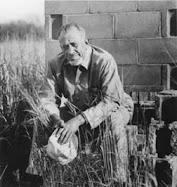
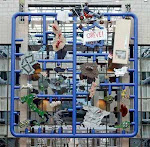
I love this photo of writer Michael Chabon (pronounced, in his words: "Shea as in Shea Stadium, Bon as in Bon Jovi") meticulously sorting his kids' Legos. Chabon is married to writer Ayelet Waldman, author of Bad Mother: A Chronicle of Maternal Crimes, Minor Calamities and Occasional Moments of Grace; she posted this to her facebook page. At least one of their four children, I'm guessing, must be a Lego fan. 

(Ayelet had a Bad Mother blog that I linked to above, and now she has a website here. I miss the Bad Mother, where she did mention how all-consuming blogging can be. Ah, yes..that is the danger.)

I just have one – or maybe two – more things to say. First of all, you know he's not doing this for his kids, right? He's plotting his next novel in his head. Or letting go of the writing for awhile with this Montessori procrastination "work job."  (God forbid that they also have the K'nex system.)

He's bringing order to the Universe. Somebody has to do it: who better than a novelist?
One small brick at a time.


In 2000, Chabon told The New York Times that he kept a strict schedule, writing from 10 a.m. to 3 p.m. each day, Sunday through Thursday. He tries to write 1,000 words a day. Commenting on the rigidity of his routine, Chabon said, "There have been plenty of self-destructive rebel-angel novelists over the years, but writing is about getting your work done and getting your work done every day. If you want to write novels, they take a long time, and they're big, and they have a lot of words in them.... The best environment, at least for me, is a very stable, structured kind of life."

Actually, that schedule sounds fabulous to me:  five days of five hours of uninterrupted writing. Not a bad life. But that was before  Ida-Rose was born (2001), followed by Abraham (2003). My guess is that there has been a major infusion of Legos in the interim.

My Lego memories: walking into the upstairs playroom in Belgium when my sister's family lived there, to find no furniture, but a mountain of Legos in the center of the room. Most impressive! It's was like the fairy tale, where the princess must turn a mound of grain into gold. (Kathy may have been something of a "bad mother": no parental sorting going on.)

Then there was the sorting I did when Jack was young. (Legos, K'nex, and Playmobile systems). 

On a trip to Germany, where my mother-in-law keeps a wooden box with Legos from her sons' childhoods, we made a fairly elaborate construction on the attic floor, but missed the more exotic contemporary pieces; these were mostly bricks in primary colors. Our former neighbors created big Lego worlds while homeschooling (and called it math. which it is! absolutely.) Shopping with Thierry and his dad Andrew at Legoland at the Mall of America, and selecting a special kit for him. That Lego team-building game that happened at a work retreat (you know the one).


But here's the rub: the kids always want those new kits, or that's what we are programed to go for. You build the Starship, then go back for a new kit with mostly similar pieces. Very few people actually need new Legos after a year or two. What's harder to get enthused about is returning to the millions of tiny pieces trapped within those intricate storage systems, to create something entirely new, without a specific plan. And yet, the possibilities are clearly endless.

Here is my question for Chabon, Waldman and you: Just think about the process of searching through all of those little drawers, once they are reinstalled in their systems. Does it really facilitate creation? Or is the heap on the floor ultimately better? That's a parental zen koan I have pondered a lot. 
There's a lesson in there somewhere: tell me what it is. Leave a comment by clicking on the word COMMENT below...my "random prize generator" will be sending a gift to someone, culled from the plastic storage system of Legos that still lives at our house.

Later: Just home from an opening at the Lilly Library on the campus of Indiana University, where there was a reception for a new exhibition called Treasures of the Lilly Library: Celebrating Fifty Years. Shakespeare, Milton, Darwin ("With the author's best compliments"), and...in the next room, a display of comic books and other texts related to Michael Chabon's The Amazing Adventures of Kavalier & Clay. Here's a bit more information about that book, from Wikipedia:


Many events in the novel are based on the lives of actual comic-book creators including Jack Kirby (to whom the book is dedicated in the afterword), Stan Lee, Jerry Siegel, Joe Shuster, Joe Simon, Will Eisner, and Jim Steranko. Other historical figures play minor roles, including Salvador Dalí, Orson Welles, and Fredric Wertham. The novel's time span roughly mirrors that of the Golden Age of Comics itself, starting from shortly after the debut of Superman and concluding with the Kefauver Senate hearings, two events often used to demarcate the era.