Showing posts with label Sarah Watson. Show all posts

Monday, February 15, 2010

Sagali for Sarah Watson of the Trobriand Islands in Papua New Guinea


Today would have been the 81st birthday of Sarah Watson, my sister Katherine Lepani's mother-in-law, who died on January 21st in the Trobriand Islands of Papua New Guinea, where she lived her entire life. When I last wrote about Sarah, Kathy chimed in to give a more complete description of sagali, the complex community exchange events that take place in honor of the deceased. She commented:
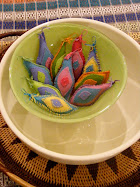
Doba is the name of the bundles of dried banana leaves that Trobriand women manufacture by the thousands for sagali, or mortuary exchange feasts. The word also refers to the banana and pandanus fibre skirts worn by girls and women (and male dancers), which also feature in sagali distributions. Cotton fabric, called karekwa after the English ‘calico,’ has been incorporated into sagali over the last several decades and is now regarded as an essential exchange item.
Bolts of fabric are cut into two-metre lengths to augment the banana leaf bundles. Women also sew special cotton skirts to wear during sagali and to use for distribution. The cloth pieces distributed at sagali are later transformed into items of clothing, sheets, pillow cases, table cloths, and curtains.
For the sagali of her maternal uncle in 2000, Sarah worked for weeks to prepare her doba. Her inventory included hundreds of banana leaf bundles stacked in a huge basket measuring three metres in circumference and one metre in height, 6 bolts of material that were cut into two-metre lengths, and 8 fibre skirts. On her old manual Singer sewing machine, Sarah made 40 cotton skirts, 22 cotton dresses, and 20 pillow cases to distribute at the sagali. The work of sagali is perpetual and passionate.
(I don't want to use the word "doba" as a tag for this post, as that is also – here in the "West" – the name for a drop ship company. I wonder how that moniker was chosen?)

Kathy's son Andrew, one of Sarah's grandsons, went to the village immediately after her death, to help with the mourning ceremonies. Sarah was buried near the house where she lived, rather than in a cemetery. Andrew is here with his uncle Noel, and also with some of his cousin brothers.


These photos give a little glimpse of end-of-life inter-generational rituals in a traditional village in the Trobriand Islands today. Kathy's commentary continues below; it refers to the big sagali that is held about six months after a death, which she will attend with her husband Charles, Sarah's son, in June.
I've got some photos to share from Andrew that convey good grief in the Trobriands--community grief manifested. It's all about clearing grief as well and in a very material fashion, through goods exchanged and food consumed. But the essence of mourning lodges deep inside everyone and that is why for months and years after a death people will still burst into sorrowful wailing when memories of the beloved are triggered.

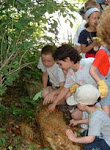
Children have the honour and task of decorating graves with fresh flowers. It's often a self-defined role--a group of children will take it upon themselves to be the ones who pick fresh flowers everyday to replenish the grave plus keep the gravesite clean. This will go on in a dedicated way until the big sagali in about six months but then will continue for years in a small and more personalized way--one or two children who will become known as the chief custodians of a particular grave. They will of course be repaid handsomely at the sagali with yams, doba, and money.
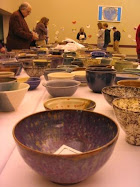
The photo of the sepwana gives you a close-up of these amazing displays of dried banana leaves. The photo of Andrew and his cousin brothers is unfortunately out of focus but I couldn't resist adding it here because of Obama's presence on the shirt worn by Bruce, the son of Sarah's younger brother Gilbert. Aggrey is at the edge of the photo.

We have some grass skirts and other doba items that have been given to us by wantoks (relatives) in the Trobriand Islands over the years (including Sarah), acknowledging our far-flung connections. Today, a tribute to the long and passionate, persistent lifespan of Sarah Watson, whose grace and influence are felt even at this great distance.

Tuesday, January 26, 2010

Clearing the Mourning, Clearing the Morning

Awake to find a 2-hour delay at the schools, due to icy roads and a bit of new snow. I keep thinking of my nephew Andrew, with his father's cousin brother Aggrey, in the Trobriand Islands to "clear the immediate mourning" for grandmother Sarah. How is that done, I wonder? One more of many skills that Andrew has.

Clearing the mourning, clearing the morning.

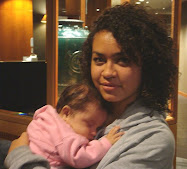
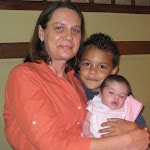
As Sarah leaves this world, a new little life unfolds: that of her great-granddaughter Tyemani, born last December 18th in Port Moresby to Suzie and Andrew. Little sister to Thierry and Thealani. Here is Andrew with his youngest child, and other sweet family photos, including one with Grandmother Kathy.

Sometimes it's hard to be far-flung! We'd love to hold this little baby, too, as would her great grandparents in Minnesota. I'm sure Sarah would also have loved to cradle her youngest little great.

Thinking of Suzie in Port Moresby, too, waiting for Andrew's (and Thierry's) returns from their travels, and then listening, with the girls, to their stories. Safe journeys!


Sunday, January 24, 2010

Ripples of Influence from a Small Island Cluster


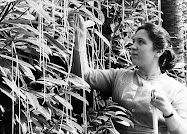
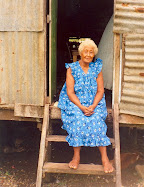
Here is a photo of Sarah Watson, my sister Kathy Lepani's mother-in-law. She is making a kind of currency or gift exchange used in sagali, memorial services for the departed. These bundles are made from scored banana leaves (also used for grass skirts) and are given in recognition of people who were important to the person who died. (Kathy, please chime in here to explain this more fully, if you wish.) I am sure there will be a lot of work to be done assembling these for Sarah's sagali, as she made so many for others during her lifetime. I like the fact that she has a little make-up bag in this photo...I wonder what she used it for? Look at the beautiful large woven basket, too. Sarah was a woman of regal bearing, wearing bare feet.

My parents wrote the words below. They once had the chance to visit Sarah's village in the Trobriand Islands. The bottom photo is of Sarah on the steps of her house, near her final resting place.

We have such vivid memories of Sarah--such a remarkable person--dignified, humorous, nurturing, generous, the center of her community.  We remember the hospitality she showed us when we visited her in Losuia, how she spread a tablecloth on the floor mat in her house, brought out her china and served us incredibly delicious meals of fish (or chicken), greens and yams. We remember her leadership and competence during a sagali we were privileged to witness. We remember her in the dark evenings sitting in her house, child in her lap, telling stories in Kiriwina, the circle of people around her listening and laughing.  On our trip by boat to Vakuta, we encountered a daunting storm;  Sarah held Genou, sea-sick, in her arms in the hold of the boat.  Holding a child is a recurring image of Sarah--it was repeated when Joyce visited her in Alitou with Kathy.

Burying Sarah in front of her house seems most fitting.  That was the center of her influence, the influence that rippled out into the world way beyond Losuia.

And my mother, Joyce Kennedy, also wrote a poem, about those ripples of influence.

January 21, 2010

Imagine a village woman who dies on this day.
In the morning she awakens as usual,
moves her old bones around her home
made partly of palm leaf;  by evening she is gone.
Put yourself into her past.
Become a child on her tropical island.
Place yourself in this woman’s arms.
The night is black, thick with stars.
Friends and relatives sit around her 
in the small space in which she lives.
She is telling stories. You listen half-asleep.  
You become part of the story, 
moving along in the soft rhythm of her words.
You know that you are safe within these words.  
How could you know that sometime in your future, 
you will understand that she is the point
in a circle that travels out in ripples,
and that after her death 
the ripples will continue to push outward
to reach other places in this world?


In Memory: Sarah Watson of the Trobriand Islands, Papua New Guinea


There has been a death in our far-flung family – my sister's mother-in-law Sarah Watson passed away in the Trobriand Islands of Papua New Guinea, where she lived all of her life. My sister relayed the news:

The day started off normally for her but by early afternoon she was feeling unwell.. She was carried to the health centre where she rested. We're not sure what treatment was provided, likely none but perhaps a saline drip (the extent of available interventions), and then she slipped away peacefully. The health officer said it was heart failure. It's rather sad that she wasn't at home but I think the relatives (Nimoa and others) would have held out hope that something could have been done for her at the health centre. Her body is back at home now and many, many people have congregated in mourning. She will be buried this afternoon before sunset in front of her house--not in the church cemetery, not in Vakuta next to her husband, [Lepani Watson] but in the ground that was her home for so many of her long years and very public and generous life. As you know, there is no morgue in Trobs and custom and commonsense require quick burial. The flights to Trobriands are on Sundays and Wednesdays. Andrew and Aggrey (Charles's cousin brother whom Sarah raised) will travel on Sunday and clear the immediate mourning. We are planning to make a trip in June for her sagali and to put up her gravestone. Sarah would have turned 81 on February 15. It is just short of a year ago that she was with us here in Canberra.

This is a day of quiet reflection, celebrating her remarkable life, and fun and playfulness, celebrating Thierry's 8th birthday. 

Thierry is the son of Andrew Lepani, one of Sarah's grandsons. Thierry is on the edge of the boat carrying Sarah, above, along with two other boys from the village. My sister says, "The person poling the boat is a young village boy. I believe it's most likely Justin, son of Wilson, Charles's cousin brother, but I can't quite make him out. The little guy with Thierry is Kennedy, also one of Wilson's sons, named after our father!" Andreas keeps this photo as the wallpaper on his computer. Sarah didn't use a computer, but she lived close to the sea all of her life. Even in old age, she was often barefoot.

The family has been collecting photos of Sarah; here are a few. In many photos she has a child in her lap. Besides her own son and daughter, she raised many other children, and she was a grandmother and great-grandmother. Below, she is with my sister's three children when they were young. And there's a photo of Nimoa, about whom Kathy says: "Nimoa is the first born son of Julie, Charles's sister. Sarah raised him from the time he was a baby, so they are very close. Nimoa always lived in the village with her and he built his house next to hers." There's a photo of Thierry here, too, in traditional dress. The final picture is one of Sarah last year visiting her son Charles's family in Canberra, Australia, standing on Mount Ainslie. (I love the sweater she is wearing there!)
Here in Indiana, far far away, we are also thinking about Sarah, wishing we had met her, and wishing we could be there to participate in the mourning. She had a huge impact on the life in her village, and led a life of great simplicity, complexity, and dignity. Our hearts go out to all of those whose lives she helped stabilize and enrich with her loving attention, day after day.