Showing posts with label Charles Darwin. Show all posts

Friday, March 19, 2010

Photos from the Galápagos Islands, by Ginger Oppenheimer

The Galápagos Islands are famed for their endemic species, unique to this archipelago of volcanic islands in the Pacific Ocean west of continental Ecuador, near the equator. Charles Darwin traveled there during the voyage of the Beagle, making observations and amassing collections that later contributed to his theory of evolution by natural selection.

Ginger Oppenheimer traveled there in 1999, inspired by a book she read about the settling of the island of Floreana by the German Wittmer family. She took a camera and began to discover a passion for photography, collecting images such as these of the species she encountered: blue-footed boobies, giant tortoise, lizards and sea lions. I think they are exquisite and humbling portraits of other divine life forms. All rights reserved: please contact the artist at her website if you'd like more information.


Thursday, March 18, 2010

Here's who's out there: photographer Ginger Oppenheimer


Ginger Oppenheimer tells the story of how she became a photographer at her website, where you can see photo gallery collections from San Francisco, the Oregon coast, and an abstract series. I love her sense of color and texture, and was honored both this year and last when she sent me her From Here to There calendar of photo prints, which fits neatly into a CD holder. It sits on my desk at home.

Here are a couple of favorites from this year's twelve, as well as words from the artist about the evolution of this time-and-place-marking project. Speaking of evolution, tomorrow we'll see stunning photos Ginger took in the Galapagos Islands, back when she was first discovering her passion for photography. Click in!

I've produced seven years of the From Here to There Calendar. I had actually received a gift in the mid-90s of a similar calendar and was so taken by the concept that I kept it for quite a while. When I began taking photos in earnest starting in 1999 when I went to the Galapagos, the first thing I did was make photo cards for friends and I gave sets of them away. I always had that gift calendar in the back of my mind and as the holidays approached in 2002, I decided very last minute to make a calendar like the one I'd received. That first year I made 50 of them and gave them all away. I got so much great feedback I decided to do it again the next year...and the next...the only year I didn't make a calendar there was a bit on my own personal calendar: in 2006 I got married and my husband and I did a giant reconstruction project on our house. I decided a calendar really wasn't part of the picture for 2007.
The name came from the concept of my travels because not only did I get on planes a lot during that time, but I also began concentrating on my own backyard, literally. I was starting to garden a lot and I began photographing all the amazing blooms. And I realized a style was emerging in my photography: I kept wanting to get closer and closer to things and what seemed to catch my eye were shadows, patterns, and intensity of color. From there I jumped to extreme close-ups on, mostly, distressed metal, and these, when enlarged and printed on canvas, look like abstract paintings.
Since switching to digital imagery (film now seems so terribly old-fashioned, yet, it wasn't that very long ago!), I've felt a real freedom to snap away with the challenge of finding the gem among the rough.  
This year's calendar feels like it hangs together sweetly. While I usually try to have imagery from as many places as possible, this year I concentrated on San Francisco, Napa Valley, and Portland. For whatever reason, there are a lot of windows. And the three flower images are three different varieties of poppies all grown in my yard.


Thursday, February 4, 2010

These Are the Cities Marco Polo Left Behind


I was recently at the extraordinary Lilly Library, on the campus of Indiana University, for the opening of their Treasures exhibition, commemorating their fiftieth anniversary.

I saw Marco Polo's Buch des edelen Ritters und Landfahrers Marco Polo (Nuremberg, 1477), and one of my friends is suggesting that our book club investigate Marco Polo. It's another gap in my education, and would probably be fascinating on the heels of reading Charles Darwin (moving even further back in time, with the explorers). Here is a teaser about the book:
1298: Marco Polo was captured during a civil war between Venice and Genoa. During his imprisonment, he dictated a detailed account of his travels to a fellow prisoner. The resulting book (known alternately as “Il Milione,” “The Description of the World” or “The Travels of Marco Polo”) became a huge success in Europe, 200 years before the invention of the printing press.
It would also help me read more deeply into the poem here by Joyce Kennedy (my mother), once made into a beautifully illustrated letterpress-printed broadside by artist and printer Regula Russelle, also of the Laurel Poetry Collective in the Twin Cities (and one of my prized possessions).

       These Are the Cities Marco Polo Left Behind
– cities invisible on road of silk,
scattered into time, cities that dazzled
eye and mind, cities possessed
by passion for wealth, dense cities
of desire, and the lost cities of youth,
those of mirrors and illusion.

And not behind,
the one where we all live,
inferno of the living,
in welter of contradiction,
just city and unjust city
wrapped one within the other.

Crammed into time until the city pleads:

Learn who and what are not inferno,
then make them endure, give them space.

A just city for its children.

Visible, shining, on road of silk.

– Joyce Kennedy [all rights reserved]
              italics by Italo Calvino, Invisible Cities

Friday, January 22, 2010

Le'go those Legos! Michael Chabon Sorts


I love this photo of writer Michael Chabon (pronounced, in his words: "Shea as in Shea Stadium, Bon as in Bon Jovi") meticulously sorting his kids' Legos. Chabon is married to writer Ayelet Waldman, author of Bad Mother: A Chronicle of Maternal Crimes, Minor Calamities and Occasional Moments of Grace; she posted this to her facebook page. At least one of their four children, I'm guessing, must be a Lego fan. 

(Ayelet had a Bad Mother blog that I linked to above, and now she has a website here. I miss the Bad Mother, where she did mention how all-consuming blogging can be. Ah, yes..that is the danger.)

I just have one – or maybe two – more things to say. First of all, you know he's not doing this for his kids, right? He's plotting his next novel in his head. Or letting go of the writing for awhile with this Montessori procrastination "work job."  (God forbid that they also have the K'nex system.)

He's bringing order to the Universe. Somebody has to do it: who better than a novelist?
One small brick at a time.


In 2000, Chabon told The New York Times that he kept a strict schedule, writing from 10 a.m. to 3 p.m. each day, Sunday through Thursday. He tries to write 1,000 words a day. Commenting on the rigidity of his routine, Chabon said, "There have been plenty of self-destructive rebel-angel novelists over the years, but writing is about getting your work done and getting your work done every day. If you want to write novels, they take a long time, and they're big, and they have a lot of words in them.... The best environment, at least for me, is a very stable, structured kind of life."

Actually, that schedule sounds fabulous to me:  five days of five hours of uninterrupted writing. Not a bad life. But that was before  Ida-Rose was born (2001), followed by Abraham (2003). My guess is that there has been a major infusion of Legos in the interim.

My Lego memories: walking into the upstairs playroom in Belgium when my sister's family lived there, to find no furniture, but a mountain of Legos in the center of the room. Most impressive! It's was like the fairy tale, where the princess must turn a mound of grain into gold. (Kathy may have been something of a "bad mother": no parental sorting going on.)

Then there was the sorting I did when Jack was young. (Legos, K'nex, and Playmobile systems). 

On a trip to Germany, where my mother-in-law keeps a wooden box with Legos from her sons' childhoods, we made a fairly elaborate construction on the attic floor, but missed the more exotic contemporary pieces; these were mostly bricks in primary colors. Our former neighbors created big Lego worlds while homeschooling (and called it math. which it is! absolutely.) Shopping with Thierry and his dad Andrew at Legoland at the Mall of America, and selecting a special kit for him. That Lego team-building game that happened at a work retreat (you know the one).


But here's the rub: the kids always want those new kits, or that's what we are programed to go for. You build the Starship, then go back for a new kit with mostly similar pieces. Very few people actually need new Legos after a year or two. What's harder to get enthused about is returning to the millions of tiny pieces trapped within those intricate storage systems, to create something entirely new, without a specific plan. And yet, the possibilities are clearly endless.

Here is my question for Chabon, Waldman and you: Just think about the process of searching through all of those little drawers, once they are reinstalled in their systems. Does it really facilitate creation? Or is the heap on the floor ultimately better? That's a parental zen koan I have pondered a lot. 

There's a lesson in there somewhere: tell me what it is. Leave a comment by clicking on the word COMMENT below...my "random prize generator" will be sending a gift to someone, culled from the plastic storage system of Legos that still lives at our house.

Later: Just home from an opening at the Lilly Library on the campus of Indiana University, where there was a reception for a new exhibition called Treasures of the Lilly Library: Celebrating Fifty Years. Shakespeare, Milton, Darwin ("With the author's best compliments"), and...in the next room, a display of comic books and other texts related to Michael Chabon's The Amazing Adventures of Kavalier & Clay. Here's a bit more information about that book, from Wikipedia:


Many events in the novel are based on the lives of actual comic-book creators including Jack Kirby (to whom the book is dedicated in the afterword), Stan Lee, Jerry Siegel, Joe Shuster, Joe Simon, Will Eisner, and Jim Steranko. Other historical figures play minor roles, including Salvador Dalí, Orson Welles, and Fredric Wertham. The novel's time span roughly mirrors that of the Golden Age of Comics itself, starting from shortly after the debut of Superman and concluding with the Kefauver Senate hearings, two events often used to demarcate the era.

Wednesday, January 20, 2010

Rotorbrain: Color Theory and Other Interactivities


Over at Jonathan Foote's Rotorbrain Industries, you'll find two color interaction demonstrations that let you play with some of the concepts of Josef Albers' color theory.

The first one demonstrates how context influences our perception of colors. (You manipulate sliders to see how this works.)

The second demonstrates how color can influence our spatial perception.

This is a very rich, deep and remarkable website, where you can jump to "another damnable blog" (waxing prolix), and find wonderful photos by David Hilbert from the Galapagos Islands, set to music.

(By the way: Why is it that when my Ladies' Book Club gets onto something, such as reading Darwin, I then run into Darwin at every turn? In the latest issue of The New Yorker, for example, Anthony Lane discusses a new film about Darwin, "Creation," by Jon Amiel).


Foote makes light sculptures (such as this Cage Lamp), invents things (a micro rhythm orchestra, electronic color goggles, mapping code, robotic avatars for desktop teleconferencing – the array of creations is brain-rotoring, indeed. Art meets science meets design meets exceptional curiosity and (dare I venture?) brilliance. The photo here of some of his light art is by Michael Prados.

Perhaps my favorite page, for personal reasons (at least tonight) is a very simple one, from the Interactivities page:

For Marie (hint: use the mouse). I have a good friend with that name, and suspect that she may enjoy clicking and scrolling over there!

There's even a Hope-Fear Meter light sculpture: that seems timely and relevant today. (Isn't this a fabulous photo?)


Tuesday, January 12, 2010

"The Tree of Life" by Peter Sís

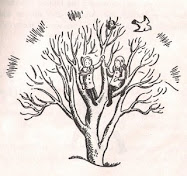
Author and illustrator Peter Sís has written a children's book about Charles Darwin called 'The Tree of Life'. Follow the link to see an animated excerpt. Like many children's books, it's a good place for adults to learn, too. The cover of the book is especially beautiful. Many thanks to Serial Susan for sending me to his work.


This lovely website includes a Tibetan maze, with more than one pathway to the butterfly in the center. See if you can find your way there!

Thursday, January 7, 2010

Serial Readers Discuss 'Wives and Daughters'

My friend Serial Susan writes a blog called Serial Readers. This is an excellent place to engage in an on-going web-based book group, with guidance from a scholar. Susan David Bernstein’s (English) research and teaching focus (at the University of Wisconsin Madison) is on Victorian literature and culture, nineteenth-century transatlantic literature, as well as feminist theory and women’s writing. She's also co-taught a course on Darwin, but more on that another day.

The blog features chapter-by-chapter entries, calling attention to themes and interesting bits of the current book. Comments come from other dedicated readers. You can jump in back where the entries for a particular book began, and hasten to catch up.


Right now the serial readers are immersed in Wives and Daughters, a wonderful novel (or "every-day story") by Elizabeth Gaskell, first published in the Cornhill Magazine from August 1864 to January 1866. When Mrs. Gaskell died suddenly in 1865, the book was incomplete; the last section was written by Frederick Greenwood. The story revolves around Molly Gibson, only daughter of a widowed doctor living in a provincial English town in the 1830s.

There's a link at Serial Readers to a piece about web-based novels, or wovels. Making me wonder, will that irksome-yet-clever word also catch on?

Tuesday, January 5, 2010

Diversity Trees from Susan Bee (Diversitrees)

While reading Charles Darwin, I find myself thinking about those Trees of Life. I really love what I'm calling "diversity trees," created by artist Susan Bee – paintings with many surprises in the branches. I wonder if she thought about Darwin at all when developing her tree-tropes.

They make me wonder: what sort of objects and items live on my diversity trees? Divinity trees. Trees of natural and not-so-natural selection.

What lives on yours?

Here is In a Medieval Garden:


And here is Butterfly Boy Drawing, which I currently use as wallpaper on my laptop.


Ice Cream seems relevant, too. (This appears to be a body-image piece, with ice cream in an ambivalent role):


Aren't they amazing? Here's another, from a cover of Fox, a collection of poems by Adrienne Rich:


Monday, January 4, 2010

Darwin Tattoos and the Tree of Life


Darwin is famous for his Tree of Life hypothesis, and we talked yesterday about how his ideas predict the science of ecology (here is that Wikipedia definition):

Ecology (from Greek: οἶκος, "house" ; -λογία, "study of") is the interdisciplinary scientific study of the interactions between organisms and their environment.[1] Ecology is also the study of ecosystems. Ecosystems describe the web or network of relations among organisms at different scales of organization. Since ecology refers to any form of biodiversity, ecologists can conduct research on the smallest bacteria to the global flux of atmospheric gases that are regulated by photosynthesis and respiration as organisms breath in and out of the biosphere. Ecology is a recent discipline that emerged from the natural sciences in the late 19th century. Ecology is not synonymous with environment, environmentalism, or environmental science.


The only image in the original On the Origin of Species is a tree diagram representing Darwin’s model for the theory of evolution. It looks like this (kind of like a musical score):


The first draft of his Tree of Life is a sketch in the little black notebook B (now at Cambridge University), from July 1837. The text reads:


I think

Case must be that one generation then should be as many living as now. To do this & to have many species in same genus (as is) requires extinction.

Thus between A & B immense gap of relation. C & B the finest gradation, B & D rather greater distinction. Thus genera would be formed. — bearing relation (page 36 ends - page 37 begins) to ancient types with several extinct forms.


And here is that sketch on the body of a contemporary Darwin devotee (below), found at the site of Michael D. Barton ("Darwin's bulldog," writing from Bozeman, Montana), Dispersal of Darwin. Looks a bit like a wound with stitches.


There are many more Darwin tattoos, including those over at the Discover blog. Here's an impressive one of  the portrait variety: "Got it at Darwin City Tattoos, in Darwin, Australia. The artist is Blue aka Mat Selwyn."


Sunday, January 3, 2010

Turnspit Dogs, from On the Origin of Species


I finally read (most of) On the Origin of Species, by Charles Darwin, and this afternoon gathered with a group of women friends to discuss it. We ate baked apples, roasted sweet potatoes, deliciously flavored onion rings, and other things – and compared our thoughts about this extraordinary work, which most of us (college graduates all) had never previously read.


In preparation, I watched a Nova special called What Darwin Never Knew, a very helpful update focusing on the impact of "the world's biggest idea" (evolution) on the birth of modern science and its many branches. We are now 200 years after Darwin's birth and 150 since the first publication of Origin. 


There were a few exclamation marks in the margins. We noted this disturbing anthropological observation: "We see the value set on animals even by the barbarians of Tierra del Fuego, by their killing and devouring their old women, in times of dearth, as of less value than their dogs."


But it was the turnspit dog that most made us sit up and bark. The reference is in Chapter One, "Variation Under Domestication." Here is an example of Darwin's prose:


One of the most remarkable features in our domesticated races is that we see in them adaptation, not indeed to the animal's or plant's own good, but to man's use or fancy. Some variations useful to him have probably arisen suddenly, or by one step; many botanists, for instance, believe that the fuller's teasel, with its hooks, which can not be rivalled by any mechanical contrivance, is only a variety of the wild Dipsacus; and this amount of change may have suddenly arisen in a seedling. So it has probably been with the turnspit dog; and this is known to have been the case with the ancon sheep. But when we compare the dray-horse and race-horse, the dromedary and camel, the various breeds of sheep fitted either for cultivated land or mountain pasture, with the wool of one breed good for one purpose, and that of another breed for another purpose; when we compare the many breeds of dogs, each good for man in different ways; when we compare the game-cock, so pertinacious in battle, with other breeds so little quarrelsome, with "everlasting layers" which never desire to sit, and with the bantam so small and elegant; when we compare the host of agricultural, culinary, orchard, and flower-garden races of plants, most useful to man at different seasons and for different purposes, or so beautiful in his eyes, we must, I think, look further than to mere variability. We can not suppose that all the breeds were suddenly produced as perfect and as useful as we now see them; indeed, in many cases, we know that this has not been their history. The key is man's power of accumulative selection: nature gives successive variations; man adds them up in certain directions useful to him. In this sense he may be said to have made for himself useful breeds.

We found more on turnspit dogs in Wikipedia (of course) with this image from "Notes on a Tour to North and South Wales," published in 1800. And here's a taxidermied turnspit ("the last remaining example") found at the blog Scribal Terror.


The Turnspit Dog is a short-legged, long-bodied dog bred to run on a wheel, called a turnspit or dog wheel, to turn meat. The type is now extinct. It is mentioned in Of English Dogs in 1576 under the name Turnespete. Rev. W. Bingley's Memoirs of British Quadrupeds (1809) also talks of a dog employed to help chefs and cooks. It is also known as the Kitchen Dog, the Cooking Dog, the Underdog and the Vernepator. In Linnaeus's 18th century classification of dogs it is listed as Canis vertigus. The breed was lost since it was considered to be such a lowly and common dog that no record was effectively kept of it. They are related, it is believed, to the Glen of Imaal Terrier.

The Vernepator Cur was bred to run on a wheel in order to turn meat so it would cook evenly. This took both courage (to stand near the fire) and loyalty (not to eat the roast). Due to the strenuous nature of the work, a pair of dogs would often be worked in shifts. This may have led to the proverb 'every dog has his day.' The dogs were also taken to church to serve as foot warmers. One story says that during service at a church in Bath, the Bishop of Gloucester, gave a sermon and uttered the line "It was then that Ezekiel saw the wheel...". At the mention of the word "wheel" several turnspit dogs, who had been brought to church as foot warmers, ran for the door.


Human ingenuity never ceases to amaze me. Will we bring some kind of turnspit animal back?