I once had a close friend who sometimes said "I'm thinking of you even when I'm not thinking of you." As far as relationships go (if those are warm thoughts) it doesn't get much better than that. He also liked to use the phrase "a friend to the end," echoing an indelible childhood spelling lesson. No longer alive, he remains a powerful ghost, an influence and inspiration.
We slip in and out of each others' lives, representing what? exactly. How do we pay homage to the countless ghosts who flitter around, moving in and out of our consciousness in apparently random ways? And then there are those invasive others: the mosquitoes, cockroaches, snakes in the grass. Today there are also twitters and tweets.
Not to mention public figures. Now we see, framed by physical finality, the exemplary life of the stellar Paul Newman: actor, philanthropist, husband, father, champion of hope, laughter, and healthier foods.
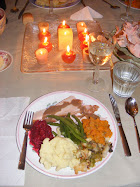
I seem to be someone who feels deeply indebted to inspiring ghosts, living and otherwise. Looking at the title of my mother's book, I suppose I must come by this naturally. Here is her poem of that title, drawing on the theater tradition of leaving a single light burning in the dark after actors and audience have departed.
GHOST LAMP
The most precious
thing is hidden
within its home
of body – that spark,
that spark of spirit
that shines, that shines
no matter what,
as if it were a ghost lamp,
the bare bulb left burning
in the hush of night
in the darkened theater
after everyone has gone.
"Ghost Lamp" by Joyce Kennedy, from Ghost Lamp. © Laurel Poetry Collective, 2006.
Showing posts with label ghosts. Show all posts
Showing posts with label ghosts. Show all posts
Monday, September 29, 2008


Sunday, September 28, 2008
Compost and Living Ghosts
No, I'm not talking about Green Machines and worm castings here – or, if so, only in a metaphorical way. My topic today is literature.
I have a 1946 copy of a Vintage paperback ($1.65) of Stories by Elizabeth Bowen. Bowen is an Anglo-Irish writer who lived from 1899-1973, author of many novels, short stories and memoirs, including The House in Paris and The Death of the Heart. If you click on the photo at the left, you go to an excellent book review of a biography of Bowen, written by novelist Stacey D'Erasmo for the New York Times. Looking at this haunting photograph, I have to wonder: what became of those 6 serious young women gathered around Bowen's chair at Bryn Mawr in 1956? And don't you just love their clothes?
I'm only beginning to read Bowen now, despite a long interest in (Anglo) Irish literature and women writers. It follows well on the Ghost Lamp theme: Bowen made use of the idea of the ''living ghost''– a ghost that appears in one place even while the living person is walking around in another. As D'Erasmo notes, "It's a beautifully condensed image of many things, not least of which is the novel itself."
Bowen wrote her own preface to Stories by Elizabeth Bowen, in which she asks "What kind of stories does, or did, Elizabeth Bowen write?" (treating herself like a living ghost). These few pages are compressed with fascinating comparisons of various genre: poetry, short stories, and the novel.
I especially like this one: "Fortunately, however, there are many other writers; taken all-in-all we complement one another – literature is a compost to which we are each contributing what we have. The best an individual can do is concentrate on what he or she can do, in the course of a burning effort to do it better."
I have a 1946 copy of a Vintage paperback ($1.65) of Stories by Elizabeth Bowen. Bowen is an Anglo-Irish writer who lived from 1899-1973, author of many novels, short stories and memoirs, including The House in Paris and The Death of the Heart. If you click on the photo at the left, you go to an excellent book review of a biography of Bowen, written by novelist Stacey D'Erasmo for the New York Times. Looking at this haunting photograph, I have to wonder: what became of those 6 serious young women gathered around Bowen's chair at Bryn Mawr in 1956? And don't you just love their clothes?
I'm only beginning to read Bowen now, despite a long interest in (Anglo) Irish literature and women writers. It follows well on the Ghost Lamp theme:
Bowen wrote her own preface to Stories by Elizabeth Bowen, in which she asks "What kind of stories does, or did, Elizabeth Bowen write?" (treating herself like a living ghost). These few pages are compressed with fascinating comparisons of various genre: poetry, short stories, and the novel.
I especially like this one: "Fortunately, however, there are many other writers; taken all-in-all we complement one another – literature is a compost to which we are each contributing what we have. The best an individual can do is concentrate on what he or she can do, in the course of a burning effort to do it better."
Saturday, September 27, 2008
The World is Like a Sponge
Tired of the world absorbing you and squeezing you out? Try looking at it from another direction: poetry. A good way in is through Garrison Keillor's The Writer's Almanac.
The poem below, by Joyce Kennedy, is from Ghost Lamp, a book published by the Laurel Poetry Collective in the Twin Cities. It is about Joyce's father, Erling (who was my grandfather). "Who Will Know?" has been read twice on The Writer's Almanac. (Mom was paid $100 each time: as she puts it, "Who says you can't make money writing poetry?") You can click on the image of Ghost Lamp to get there.
The poem below, by Joyce Kennedy, is from Ghost Lamp, a book published by the Laurel Poetry Collective in the Twin Cities. It is about Joyce's father, Erling (who was my grandfather). "Who Will Know?" has been read twice on The Writer's Almanac. (Mom was paid $100 each time: as she puts it, "Who says you can't make money writing poetry?") You can click on the image of Ghost Lamp to get there.
Who Will Know?
He wanted to stay.
He didn't ask for much.
He wanted to know what was "going on,"
He read the paper every day.
The world is like a sponge.
It absorbs us.
Mother was grieved with the nursing home.
He said, "Kiddo, it's all right."
The world goes on its way.
Now that he's gone, who will know?
Subscribe to:
Posts (Atom)























.jpg)












.jpg)