Showing posts with label Joyce Kennedy. Show all posts

Tuesday, March 2, 2010

Hard Up: 'Pinching Pennies' by Joyce Kennedy


I sent James Moore this poem yesterday, written by my mother, Joyce Kennedy. It recalls her childhood during the depression in small town North Dakota. My mom has often said that she always felt like her family had enough of everything; nevertheless, an awareness of tight times comes through in this timely-once-again poem. There's a child's observation of language, too.


Pinching Pennies

   I tried to get out of the country,
   But poverty forced me to stay…
                                The Old Settler's Song

Back then, my mother and father said
money was scarce--they talked of getting by.
Those were hard times--my mother's sister,
Mattie, and her family, were hard up.
"But Mattie keeps her house so clean,
you can eat off the floor," my mother said.
Almost everyone had to pinch pennies,
some folks were flat broke--
wasn't the whole country down on its luck?

"Money doesn't grow on trees," said Dad;
even if it did, trees on prairie were few.
"They're poor as church mice," said Mother,
creating for me a picture of little mice-children
scampering across the floor of the church basement,
scrabbling for crumbs from the Ladies' Aid.

Set back from a country road, it was 
the poorhouse afflicted my young heart.
Low and ramshackle, it looked about
to fall down, so poor it was in spirit.
"Poor house," I thought as we drove by,
 feeling sorry. That was where we would go
 if we got to be too hard up--
 "We'll end up in the poorhouse!"
We would reach rock bottom,
flat as prairie, not up in any way.

Joyce Kennedy

®all rights reserved

Saturday, February 27, 2010

Happy Birthday, Joyce!

Another year has come around, and I'm so grateful to say that it is the birthday again of my beloved mom, Joyce Kennedy. We talked on the phone today, before she headed out with Wally-Dad for dinner at Brasa Rotisserie, followed by a performance by the extraordinary TU Dance at the Ritz Theater in Minneapolis. It's a cabaret performance set to jazz standards, with dancers Toni-Pierce Sands and Uri Sands collaborating with the Jeremy Walker Quartet and actor/musician T. Mychael Rambo: chamber dances exploring concepts of respite in the city, drawing on Uri's memories of Central Park.

As Joyce put it: "Not a bad date for a woman in her eighties!" (Actually, she said "for an olede": old lady in Papua New Guinea pidgin.)


I'm so grateful for my kind and intelligent mother, who is shown here exploring respite in the woods, during a not-that-long-ago canoe trip.  Happy birthday, Mom! We love you.

Sunday, February 14, 2010

Happy (Vintage) Valentine's Day

When my grandmother Mary died a number of years ago, I traveled to Bismarck, North Dakota, with my parents for memorial services and to clean out the modest apartment where she lived for many years. My grandmother lived on her own until she passed away in her mid-nineties, taking pride in her ability to remain independent. She had help from a social service agency, from her friend Marion (and others), and from her grand-daughter Amy. She remained active, energetic, and strong-willed, helping others, going to church, and making gifts of handmade baby booties, afghans, slippers, and quilts. She liked to tell stories when visitors came around for coffee.


One of the things we found was a shoe box filled with valentines from the late 40s and early 50s. Most had been given by relatives and friends to Mary's son David when he was a little boy. Simple and colorful, with corny sentiments abounding, they have a kind of graphic charm. (Warhol might have changed the scale to make large silk screened canvases.) I like the ingenious die cuts; very few are square or folded. These are the kinds of cards that were put into decorated cardboard classroom shoe boxes; many are signed by young friends. There's a profusion of quotation marks, at every "hint" of a metaphor.

We offer reproductions of these at Bloomingfoods at this time of year, as a benefit for Area 10 Agency on Aging, an organization offering support services to the elderly and their caregivers. These cover the walls of the stores with good wishes, sent out in the names of ones who are loved; I always buy one or two in memory of my grandmother. Here are just a few.

Thursday, February 4, 2010

These Are the Cities Marco Polo Left Behind


I was recently at the extraordinary Lilly Library, on the campus of Indiana University, for the opening of their Treasures exhibition, commemorating their fiftieth anniversary.

I saw Marco Polo's Buch des edelen Ritters und Landfahrers Marco Polo (Nuremberg, 1477), and one of my friends is suggesting that our book club investigate Marco Polo. It's another gap in my education, and would probably be fascinating on the heels of reading Charles Darwin (moving even further back in time, with the explorers). Here is a teaser about the book:
1298: Marco Polo was captured during a civil war between Venice and Genoa. During his imprisonment, he dictated a detailed account of his travels to a fellow prisoner. The resulting book (known alternately as “Il Milione,” “The Description of the World” or “The Travels of Marco Polo”) became a huge success in Europe, 200 years before the invention of the printing press.
It would also help me read more deeply into the poem here by Joyce Kennedy (my mother), once made into a beautifully illustrated letterpress-printed broadside by artist and printer Regula Russelle, also of the Laurel Poetry Collective in the Twin Cities (and one of my prized possessions).

       These Are the Cities Marco Polo Left Behind
– cities invisible on road of silk,
scattered into time, cities that dazzled
eye and mind, cities possessed
by passion for wealth, dense cities
of desire, and the lost cities of youth,
those of mirrors and illusion.

And not behind,
the one where we all live,
inferno of the living,
in welter of contradiction,
just city and unjust city
wrapped one within the other.

Crammed into time until the city pleads:

Learn who and what are not inferno,
then make them endure, give them space.

A just city for its children.

Visible, shining, on road of silk.

– Joyce Kennedy [all rights reserved]
              italics by Italo Calvino, Invisible Cities

Tuesday, January 26, 2010

God ghazal, by Marie Deer

My friend Marie works with words in many ways: as a writer of novels that no one yet reads (she is a big fan of NaNoWriMo: National Novel Writing Month, each November, and has participated in that for two or three years); as an editor of textbooks and other scholarly writing (she is fluent in several languages, with a linguistics degree from a certain university in New Haven that will today go unnamed); as a writing coach, coaxing those who need to slog through sometimes intimidating projects; as the keeper of a blog; and as a poet.

She is also a fiercely brilliant word gamer, a worthy opponent for anyone daring enough to take her on in Scrabble, Lexulous, Boggle, or other word games, both on-line and at the dining room table. (Serial Susan has been her gaming friend, and it is rumored that Marie has taken down a few noted professional deconstructionists in her day.) I can't do it, I'm hopeless at such things once the heat is on: I need my word games to be very slow and contemplative, as I am apt to go down a rabbit hole and forget that I'm trying to beat either the clock or anyone but myself.

Anyway, that is a long introduction to the piece of writing I am posting today. Marie recently went on a Women Writing for (a) Change Bloomington weekend writers' retreat, and she focused on a favorite form, the ghazal. She's been sharing some of her ghazals the past few days, and gave me permission to post. I think they are very remarkable. I'm happy to serve as her literary agent if there are any book publishers out there looking for a next great poet. (I am also happy to represent my mother, Joyce Kennedy, whose extraordinary manuscript of poems about Shakespeare's female characters, Will's Women, needs a publishing home.)

There is a pattern to the ghazal. Without cheating and reading about it, can you discern what it is?

God ghazal

God has a place, surely, somewhere to be, at least some little nook for God.
And God has a shape, pentagod or octagod or something, or how could I look for God?

In the spaces between us, that's my line, that's my God-is-love theory, so weirdly
I'm always careful of those growing and shrinking spaces, alert and on the hook for God.

God being every gender of course, he/she/they are multidomestic and omnieverywhere,
Mr. and Mrs. God I call them, sitting them down as I tie on my apron and cook for God.

Mr. and Mrs. I call them, serving them all kinds of healthy-as-sin organic wonderful
Goodies they've never seen and they marvel. I'm putting it all in a gaudily illustrated book for God.

For nobody else would I cook and clean and work like this. I've even learned new stuff.
You wouldn't believe the workshops and tutorials and classes I took for God.

Things get in the way, obviously. Kids, work, husband, parents, you-name-it. But sometimes
I just have to broom them all out of the way, get out my little schedule, and rebook for God.

Life gets knotted up. I lose my way. My shoulders and back are tight and I frown.
Life gets knotted up and I have to take it all and undo, unstitch, unhook for God.

People are running everywhere. Max far away, Michel in a book, Felix online.
I want to scoop them together and show them what I've done and say see, look, all that I undertook for God!

Mostly I need to sit in this corner, that corner, some corner somewhere where I can close my eyes.
Sit in a corner, say I am Marie, this continues true, no matter what I forsook for God.

Sunday, January 24, 2010

Ripples of Influence from a Small Island Cluster


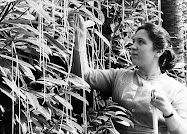
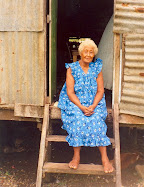
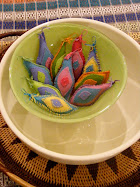
Here is a photo of Sarah Watson, my sister Kathy Lepani's mother-in-law. She is making a kind of currency or gift exchange used in sagali, memorial services for the departed. These bundles are made from scored banana leaves (also used for grass skirts) and are given in recognition of people who were important to the person who died. (Kathy, please chime in here to explain this more fully, if you wish.) I am sure there will be a lot of work to be done assembling these for Sarah's sagali, as she made so many for others during her lifetime. I like the fact that she has a little make-up bag in this photo...I wonder what she used it for? Look at the beautiful large woven basket, too. Sarah was a woman of regal bearing, wearing bare feet.

My parents wrote the words below. They once had the chance to visit Sarah's village in the Trobriand Islands. The bottom photo is of Sarah on the steps of her house, near her final resting place.

We have such vivid memories of Sarah--such a remarkable person--dignified, humorous, nurturing, generous, the center of her community.  We remember the hospitality she showed us when we visited her in Losuia, how she spread a tablecloth on the floor mat in her house, brought out her china and served us incredibly delicious meals of fish (or chicken), greens and yams. We remember her leadership and competence during a sagali we were privileged to witness. We remember her in the dark evenings sitting in her house, child in her lap, telling stories in Kiriwina, the circle of people around her listening and laughing.  On our trip by boat to Vakuta, we encountered a daunting storm;  Sarah held Genou, sea-sick, in her arms in the hold of the boat.  Holding a child is a recurring image of Sarah--it was repeated when Joyce visited her in Alitou with Kathy.

Burying Sarah in front of her house seems most fitting.  That was the center of her influence, the influence that rippled out into the world way beyond Losuia.

And my mother, Joyce Kennedy, also wrote a poem, about those ripples of influence.

January 21, 2010

Imagine a village woman who dies on this day.
In the morning she awakens as usual,
moves her old bones around her home
made partly of palm leaf;  by evening she is gone.
Put yourself into her past.
Become a child on her tropical island.
Place yourself in this woman’s arms.
The night is black, thick with stars.
Friends and relatives sit around her 
in the small space in which she lives.
She is telling stories. You listen half-asleep.  
You become part of the story, 
moving along in the soft rhythm of her words.
You know that you are safe within these words.  
How could you know that sometime in your future, 
you will understand that she is the point
in a circle that travels out in ripples,
and that after her death 
the ripples will continue to push outward
to reach other places in this world?


Thursday, August 27, 2009

Nine Great Regrets

I've never been completely convinced by Edith Piaf's song Je ne regrette rien, as much as I admire her voice and that spirit of infinite denial. Isn't it better to regret a few things – at least at first – before moving along to perhaps transcend the sadness and self criticism associated with loss and disappointment?

I've been considering this topic as an opportunity to think about poetic language. Joyce Kennedy wrote a poem called "Nine Great Herons," which I mentioned here at elenabella. Regular reader and poet Lyle Daggett looked at the photo she took of these birds and suggested that they were really egrets. Word change: substitution of one type of bird with another that is similar. Joyce went back and revised her poem, now called "Nine Great Egrets."

I can't read that title without thinking (in quick succession) "Nine Great Regrets" and then thinking "There's another poem." Nine great regrets make their surprise appearance at early dawn, or in the dark of night, or on a Tuesday in Baltimore, walking the dog. What are they?

There are the big ones: Nagasaki, Hiroshima, the Holocaust. The destruction of the rain forest. The appalling way we often treat animals. Slavery. Sex trafficking. The wanton destruction of sacred things in the name of dogma. Cruel intentions.

See, nine already. Even without turning to those more personal regrets, too personal even to post on a public blog. Nine Great Regrets: think about them, but not until after you watch this wonderful video of Piaf.

Monday, August 24, 2009

Nine Great Egrets, by Joyce Kennedy


This previously unpublished poem comes courtesy of my mother, Joyce Kennedy, a regular walker at Wood Lake Nature Center. Joyce took yesterday's photo, too, making a reprise today. Many thanks!


NINE GREAT EGRETS


make a surprise appearance
at dusk on the pond by the path
we are accustomed to walking.
Oh, our good luck! In dissolving light,
they are bright white forms of length and curl.
They move on stilted legs.
Their long necks stretch and bend.
Their long beaks dip casually
into darkening water. Slight breeze.
Bird voices in the surrounding trees
are down to murmur, sweet little
chips of sound. In the distance,
the busy roar of freeway. Like
the egrets, we choose not to listen.
We will carry this scene home with us.
Nine Great Egrets will be lodged
within a sanctuary of our minds.
To be themselves, not metaphor.

Tuesday, May 5, 2009

Happy Birthday, Wally-Dad!


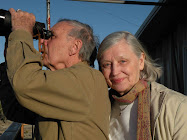
Today is the birthday of my beloved father, Wallace Kennedy, pictured here in two treasured photos from the past year: in the chair (by Joyce Kennedy), and with binoculars (by Cheryl Walsh Bellville).

My dad has always had scary-accurate recall, a great memory for names, dates and anecdotes that served him well as an educator, in a profession where he met hundreds (if not thousands) of people. He respected and admired his students, realizing that each of them was a complete person who would go on beyond the classroom in unexpected ways. I never heard him take a condescending attitude towards students; instead, he enjoys talking about the things he learned from them, or about their responses to a learning experience.

With his friend and fellow educator, Sy Yesner, Dad came up with the brilliant idea of the Urban Arts program, forging links between professional artists and the Minneapolis Schools. Unfortunately, the program later lost its funding in Minneapolis, after replication in many other cities. For a time Dad had the wildest job title: he was disseminator of arts education for the National Diffusion Network. I think that is something Obama would be wise to bring back. Wally is writing now about Urban Arts, thinking there are contemporary lessons to be gained from its history – if you have memories of involvement with the program, please contact me and I'll put you in touch with him.

A few years ago Wally wrote a memoir of his early years, called Who Do You Think You Are? What I love about this book is that it gives such a vivid glimpse of him as a child and young man, growing up during the Great Depression (–I must say, I always get a bizarre kick out of capitalizing those words), from a boyhood base in Cando, North Dakota. It's valuable beyond words to have a record of his memories captured in narrative form, along with some great early photos that I would post here, if I had them (maybe I can remedy that later). There's a quote at the beginning of the book by John Lukacs: "What happens is not separable from what people think happens."

I asked Dad for some words about the writing process, and he had this to say:

Writing my boyhood memoir was easier than I expected. Once I began recalling the earliest memories, such as my third birthday, the sights and sounds of daily life just flooded in. The "hard work" was cutting out memories that seemed unkind to anyone, but keeping the truth about experiences that shaped my growing years. Instead of writing to please a reader, I worked to avoid offending a reader. Hope that makes some sense.

Dad directed theater, taught speech, debate, literature, writing, poetry: he has a capacious interest in all subjects, and helped create the first humanities curriculum for high school in the United States. It's thanks to my dad (and mother and siblings) that there is such a wide range of topics in this blog: it was impossible to grow up with my parents and not find the world to be filled with potential and fascination. With my mom, he is one half of an entity we call "Joywal."

Even today, I envy my father's cultural life: he takes the time to attend countless theater, dance, music and writing events, and then to think about them in relation to other topics. I believe this helps explain his remarkable health and mental alertness. Oh, (and here is where we differ) – he loves to watch sports, too, even those often-exasperating Vikings and Gophers games! He is what we call (in Papua New Guinea-speak) "the bush tucker man": the one in the family who patiently hunts and gathers the groceries. He's a great cook, and makes Wally's Wonderful Waffles (which preceded the World Wide Web). He gardened for years, planting trees for all his grandchildren, and is a handyman, drawing on the skills of his own father, Noah Kennedy, who was that rare and remarkable thing, a Jack-of-all-trades. His mother, Hadie, was a nurse, gardener and midwife.

Much love, admiration, and gratitude to you today, Dad, on your birthday!

Tuesday, April 7, 2009

Happy Birthday, John!


It's the birthday of my brother John Kennedy, of Santa Fe New Music, father of Jasmine and Jade, husband of Rozella, sister to Kathy in Australia, and only son of Joyce and Wally. Here he is on the North Shore of Lake Superior, swimming in the Temperance River.

Does your head swim? That's one of my favorite questions, perhaps because mine so often does, swimming or cascading with memories, images, sounds, and ideas. Cascades: it's a word for a musician like John, someone who hears things.

1. A waterfall or a series of small waterfalls over steep rocks.
2. Something, such as lace, thought to resemble a waterfall or series of small waterfalls, especially an arrangement or fall of material.
3. A succession of stages, processes, operations, or units.
4. Electronics: A series of components or networks, the output of each of which serves as the input for the next.
5. A chemical or physiological process that occurs in successive stages, each of which is dependent on the preceding one, and often producing a cumulative effect: an enzymatic cascade.

John has done many remarkable things, not least of which is the pulling-out-of-thin-air of musical concerts and compositions year after year, first with Essential Music in New York City, and now with Santa Fe New Music in New Mexico. He also organizes and conducts the Music in Time series at the Spoleto Music Festival in Charleston, South Carolina.

If you are new to the sounds of New Music (not to be confused with New Age Music), the Santa Fe New Music site is a good place to learn: you'll find archives, a page with links to the composers featured over their first seven concert series, and a "listen up" list of recommended CDs. John has been influenced by the aleatoric or "chance" music of John Cage, whose memorial service he organized as a musical tribute (with Merce Cunningham, Yoko Ono, and others) in New York City.

You can hear clips from John's own One Body here (click on "Listen to Samples" under the CD cover): it's a composition featuring poetry by Joy Harjo, Gary Snyder, Kenneth Patchen, Walt Whitman, and others, set for the unique voice of countertenor/baritone Bruce Rameker. (Amazon has Rameker incorrectly listed as composer.) Here is more information about One Body, and the libretto. The beautiful CD cover is by painter Nancy Ortenstone, of Taos, New Mexico.

I can't listen to One Body without it bringing tears to my eyes, recalling the way my brother helped "conduct" the recovery of our father, Wally, when he ended up (almost by chance) in an intensive care unit a few years ago. John came to spend days and nights in the unit, watching the machines with intense sensitivity and intelligence, talking quietly with the night nurses. He was adept at tuning us into those moments when Dad needed us to talk to him, and he lead us in the reiki that helped prep him for the surgical procedure that saved his life. At night, in the background, this music played, providing comfort and connection for Wally. Listen to One Body, especially if you are in need of healing: it has great spiritual power.

Much love and gratitude to John on this day!

Sunday, April 5, 2009

The Outer Reaches of New Mexico...and Outer Space


My brother John and his family finished the Santa Fe New Music production of The Language of Birds, to standing ovations (here is a pre-show report from the Santa Fe Reporter's John Stege). Then they traveled to one of the more remote parts of New Mexico, near Datil, on the edge of the Cibola National Forest, near the Very Large Array.

Before I looked that up, I was imagining a very large array of rock formations: instead, this is a radio astronomy observatory that studies radio galaxies, hydrogen gas, quasars, pulsars, supernova remnants, gamma ray bursts, radio-emitting stars, the sun and planets, astrophysical masers, and black holes. Oh.

Our friends Cheryl Walsh Bellville and Don Hastings are building a house there. Cheryl is a photographer with a studio in nearby Magdalena. For years they've lived in western Wisconsin, where Don still maintains a business hauling hay and Cheryl documents life in the midwest and beyond (from a studio in St. Paul), often creating remarkable photographic children's books.

Cheryl just send me these wonderful photos of my family. She says "Your dad is looking through binoculars at the small mountain that rises behind our house. John and his girls have climbed to the top. They'd just walked out of range when I took this picture."

Tuesday, March 24, 2009

Santa Fe New Music Presents "The Language of Birds"


Rehearsals are in high gear for the Santa Fe youth opera The Language of Birds, written by my brother, composer John Kennedy, artistic director of Santa Fe New Music.

This two-act opera premiered in 2004 with the Sarasota Opera in Florida; it was showcased at the 2004 “Opera America” convention.

The Santa Fe production features a cast of some 70 young people from pre-kindergarten to age 19, working with a production and artistic team of international quality, and supported musically by a professional chamber orchestra. The cast is culturally, economically, and developmentally diverse, representing 17 schools and some homeschooled youth from seven New Mexico cities and towns, within four counties.

There are three performances this March 27 and 28 at the Lensic Performing Arts Center in Santa Fe. I so wish I was there! I'm grateful that my parents, Joyce and Wally, are going to see the show. Jasmine and Jade, my nieces, are among the cast members: that's Jasmine, above, with the gold headband, in the blue sweater; and Jade in turquoise. Their mom, Rozella Kennedy, is general manager of Santa Fe New Music.

The team effort, discipline, excitement, and validation offered to young people by an experience like this one are so valuable, with many potential ripple effects for their futures. The fact that their voices are taken seriously, that they work across a range of ages, and that they anticipate the ephemeral thrill of real theater is something they won't soon forget. It helps them integrate and coordinate many skills, from song and dance to memorization, presentation, set design and production values. And it's so much better than just watching endless reruns of High School Musical, in its various incarnations! Here, the kids are up off the couch and in their own opera. How often do they have an opportunity like that?

Saturday, February 28, 2009

"God Bless Mom"


My son Jack knows that I like songs in what we have come to call the "God Bless Mom" genre. The ur-text for these is Glen Hansard's "God Bless Mom", by the Irish group The Frames. Here is the official GBM youtube video, sent out to my own Mom-Joyce, who is spending her birthday at a hermitage retreat (with Wally, of course) in northern Minnesota. She's not twittering or logging on, but I can picture the two of them on snowshoes in the quiet of the woods.

There's something about a group of Irish lads making music on the love-your-mom theme that warms the very cockles of my heart. I can appreciate the screeching, head banging effects, too. The best version is on their Live in Dublin album, "Set List": this one is nice for the video view and the brief interview at the end on late night Irish telly with the late, lovely Uaneen Fitzsimons.

Here are the lyrics. hmmm...maybe I really should should buy the ringtone for this song.

God bless mom
Best of all
Spread your wings
Fly or fall

You'll see how hard it can be
To keep your side of the deal
And you'll see how hard it can be
To keep one foot in the real

God bless you
Strong and true
Stay at home
Good as gold

And you'll see how hard it can be
To keep your side of the deal
And you'll see how hard it can be
To keep one foot in the real


Friday, February 27, 2009

Happy Birthday, Joyce!


It's the 80th birthday of my wonderful Mom, Joyce Kennedy, an event so noteworthy that I must finally return to elenabella. (It has been a tough February, with computer complications and other unanticipated demands affecting the production of this bio-logue blog.) But the month is almost at an end, bringing at last a most magical day, a birthday rhyme-in-time: Hey, Mama! Happy Birthday!

When I have a chance, I will scan some photos of my mother over the years. For now, here is a glimpse of her at a Twins game. Born in a small town in North Dakota, her life has unfolded now for 8 full decades, something I find almost impossible to believe – until I recall Mom's steady energy, engagement, and emotional and intellectual brilliance. She loves life and lives it well.

Poet, teacher, mother, grandmother, great-grandmother, devoted partner to Wally, my mother is a wordsmith and keen participant in the world. She inspires many people with her kindness, wit, intelligence, and clear, easy determination. She was named well, finding and creating Joy in a most natural, unaffected way, nearly every day. Thank you for life, Mom, and Happy Birthday!

Monday, January 26, 2009

"Praise Song for the Day" by Elizabeth Alexander


Here is the poem that was written and read by Elizabeth Alexander last Tuesday at Obama's inauguration, typed up by my mother, poet Joyce Kennedy.

This link goes to Alexander's bio in a program for a 1994 conference called "Furious Flower: A Revolution in African American Poetry" honoring Gwendolyn Brooks – there's even a letter there from Bill Clinton, sending his and Hillary's greetings to the participants. (I wonder how often – if ever – that happened in the Bush administration.) The conference notes make me realize how little poetry we see in bookstores any longer, in even those bookstores that are still around.

I thought it was fantastic to have a poet at the inauguration, as it was to have world class musicians playing at the magical moment when power changed hands, right at noon, in advance of the bungled oath. My mother has this to say about the public response:

In googling for the poem, I was surprised to find a great deal of negative criticism. Seems people did not think it "poetic" enough--it didn't "soar," it was filled with banal, every-day images, prosaic language, etc. They didn't like the way she delivered the poem, either – the fact that people started dispersing as she was reading (I noticed that, too) meant that the words were not inspiring to them. Of course, a lot of the criticism, as in many blog responses, comes from opinionated, loud-mouthed (metaphorically) people who probably don't know a fig about poetry.

The comments come, I'm sure, from people's notions of what poetry is, what it is supposed to do. I thought Alexander's poem fit in well with Obama's respect for "the least of these," for community, and for the power of words.

I do think it is very difficult to write an "occasional" poem. One of the bloggers invoked Robert Frost, the poet at John Kennedy's inauguration (and the first one to read at such an event). But Frost wrote a banal poem for the occasion which luckily got blown away in the wind (another version has it that he couldn't see the words with his 87 year-old-eyes) so he recited one of his good poems from memory.
I didn't find Alexander's poem banal – I thought it drew well on themes associated with Obama, in language ("say it plain") that could be understood by many. It's interesting what a bad rap poetry gets (a headline in The New York Times this past week, on another topic entirely, was "No Time for Poetry"): it's usually seen as either too accessible or too obscure. I attribute this to the fact that so few people seem to read it or give it any serious thought, resorting to relatively inchoate notions of some kind of "soaring" language. Like other art forms, it exists within traditions – Alexander clearly knows them well.

(Of course the reading is on YouTube, too: the comments there are particularly dumb, of the "im not that interested in poetry and stuff but even i know poetry rymes" school of criticism.) Here's to some praise for the Praise Song – and may we always have presidents who include poets in the mix.

Praise Song for the Day:

A Poem for Barack Obama’s Presidential Inauguration

Each day we go about our business,
walking past each other, catching each other’s
eyes or not, about to speak or speaking.

All about us is noise. All about us is
noise and bramble, thorn and din, each
of our ancestors on our tongues.

Someone is stitching up a hem, darning
a hole in a uniform, patching a tire,
repairing the things in need of repair.

Someone is trying to make music somewhere,
with a pair of wooden spoons on an oil drum,
with cello, boom box, harmonica, voice.

A woman and her son wait for the bus.
A farmer considers the changing sky.
A teacher says, Take out your pencils. Begin.

We encounter each other in words, words
spiny or smooth, whispered or declaimed,
words to consider, reconsider.

We cross dirt roads and highways that mark
The will of some one and then others, who said
I need to see what’s on the other side.

I know there’s something better down the road.
We need to find a place where we are safe.
We walk into that which we cannot yet see.

Say it plain: that many have died for this day.
Sing the names of the dead who brought us here,
who laid the train tracks, raised the bridges,

picked the cotton and the lettuce, built
brick by brick the glittering edifices
they would then keep clean and work inside of.

Praise song for struggle, praise song for the day.
Praise song for every hand-lettered sign,
the figuring-it-out at kitchen tables.

Some live by love thy neighbor as thyself,
others by first do no harm or take no more
than you need. What if the mightiest word is love?

Love beyond marital, filial, national,
love that casts a widening pool of light,
love with no need to pre-empt grievance.

In today’s sharp sparkle, this winter air,
any thing can be made, any sentence begun.
On the brink, on the brim, on the cusp.

Praise song for walking forward in that light.

Elizabeth Alexander, 2009, All Rights Reserved


Monday, December 15, 2008

"Close Call" by Phebe Hanson


My mom, Joyce Kennedy, shares more with Phebe Hanson than an appreciation for Emily Dickinson and a gift for writing poetry. Both of them had Norwegian Lutheran fathers who went to college at Augsburg, near the West Bank in Minneapolis. (I wonder now if they ever knew one another, those two rather reserved men?)

I learned this in Phebe's poem, "Close Call" from her book Why Still Dance. The poem finds words for that common childhood encounter with the "incredible lightness of being" – thinking back in awe to realize just how lucky you are to have been born at all, given all the close calls out there.

If you follow this link to the Writer's Almanac, you can hear the poem read, and find 3 others by Phebe in the archive. Best of all, search out a copy of the book to buy, before they slip away. I went to Amazon and found a few, but like the work of so many great poets, there are not enough copies of Phebe's books in print or circulation. If you buy one today, you can call it a "close call": you'll never regret time spent with this book. Needless to say, it makes a great gift.

Close Call

All my life my father refused to talk about
his boyhood in Norway. "No," he'd say when
I cajoled him for details. "I'm an American now."

The only thing he'd ever talk about was how he'd
ended up in Minneapolis at Augsburg Seminary,
the story of his "close call," as he referred to it.

He was the only one of his three brothers and sister
who emigrated. "He broke our mother's heart," my aunt
told me when I visited her in Norway many years later.

She gave me the picture she'd taken the day he left, the
day after Christmas, 1920. He's impossibly young, already
wearing his life-long uniform—black suit, vest, white shirt, tie,

ready to go off to America, even if his mother's
heart is breaking, because he had to fulfill a promise
he made when he got the Spanish Flu, summer of 1918.

"Twenty two million people died," he was fond of telling me,
"twice as many as died in World War I, but I didn't die.
When I was choking and close to death, my mother

called the village doctor who performed a tracheotomy
right on our kitchen table and I promised then I'd serve
God forever if He wouldn't let me die. It was a close call."

Close call, I say, echoing my father, now dead these 20 years.
How close he came to being one of the 22 million, how he
almost didn't make it to America, almost didn't spend a

summer in Duluth, preaching at the Norwegian Seaman's
Mission, almost didn't meet my mother whose youth group
was serving coffee and cake after the service, almost didn't

marry her, almost didn't make love with her that warm June
evening of 1927, the night I was conceived, in the white frame
parsonage in Bagley, Minnesota. Close call. Close call.

Poem: "Close Call" by Phebe Hanson, from Why Still Dance © Nodin Press, 2003.

Sunday, December 14, 2008

Emily Dickinson's 178th Birthday Party


My mother sent over news and photos from Emily Dickinson's 178th birthday party, hosted at my parents' "house" (they live in a wonderful high-rise condo) on December 10th. She says there were 27-28 people there. Emily herself might have been overwhelmed by so much attention!

Here is some information from Joyce Kennedy about poet Phebe Hanson and her Emily Dickinson parties, along with a couple of photos.

Phebe has had Emily parties since 1972, starting when Emily was only 142. [I just did the math: that's 36 years!] The format since the beginning has been pretty much the same – people read their favorite Emily poems or recite the ones they know by heart. Little known poems are often read, too – lots of treasure in those. Spontaneity is emphasized – no going around a circle.

Often there will be a discussion about meaning or effect. Someone might provide a new insight into a poem or into Emily's life and/or times. We usually sing a few of the poems because with a predictable meter they adapt easily to hymns or a song like "The Yellow Rose of Texas".

All of this happens in a convivial atmosphere, this year helped along by sherry. I don't recall having sherry at any of the previous events that we have attended, but Phebe thought it would be all right since Emily mentions in one of her writings that her hair is the color of sherry that has been left in a glass for a time.


Phebe has many artifacts gathered over the years – posters, song sheets, pictures, books, etc. A couple of her friends gave her Emily Dickinson scarves – she presented me with one of them this year. In one of the photos you will see that we are wearing them.


The last part of the ritual is eating Emily's Black Cake, made from a recipe of the times. It is a rich, dark fruit cake saturated with brandy.

It's a joy to see this photo of Phebe with my mother, both looking so well.

Monday, September 29, 2008

Thinking of You (Ghosts)

I once had a close friend who sometimes said "I'm thinking of you even when I'm not thinking of you." As far as relationships go (if those are warm thoughts) it doesn't get much better than that. He also liked to use the phrase "a friend to the end," echoing an indelible childhood spelling lesson. No longer alive, he remains a powerful ghost, an influence and inspiration.

We slip in and out of each others' lives, representing what? exactly. How do we pay homage to the countless ghosts who flitter around, moving in and out of our consciousness in apparently random ways? And then there are those invasive others: the mosquitoes, cockroaches, snakes in the grass. Today there are also twitters and tweets.

Not to mention public figures. Now we see, framed by physical finality, the exemplary life of the stellar Paul Newman: actor, philanthropist, husband, father, champion of hope, laughter, and healthier foods.

I seem to be someone who feels deeply indebted to inspiring ghosts, living and otherwise. Looking at the title of my mother's book, I suppose I must come by this naturally. Here is her poem of that title, drawing on the theater tradition of leaving a single light burning in the dark after actors and audience have departed.

GHOST LAMP

The most precious
thing is hidden
within its home
of body – that spark,
that spark of spirit
that shines, that shines
no matter what,
as if it were a ghost lamp,
the bare bulb left burning
in the hush of night
in the darkened theater
after everyone has gone.


"Ghost Lamp" by Joyce Kennedy, from Ghost Lamp. © Laurel Poetry Collective, 2006.

Saturday, September 27, 2008

The World is Like a Sponge

Tired of the world absorbing you and squeezing you out? Try looking at it from another direction: poetry. A good way in is through Garrison Keillor's The Writer's Almanac.

The poem below, by Joyce Kennedy, is from Ghost Lamp, a book published by the Laurel Poetry Collective in the Twin Cities. It is about Joyce's father, Erling (who was my grandfather). "Who Will Know?" has been read twice on The Writer's Almanac. (Mom was paid $100 each time: as she puts it, "Who says you can't make money writing poetry?") You can click on the image of Ghost Lamp to get there.

Who Will Know?

He wanted to stay.
He didn't ask for much.

He wanted to know what was "going on,"
He read the paper every day.

The world is like a sponge.
It absorbs us.

Mother was grieved with the nursing home.
He said, "Kiddo, it's all right."

The world goes on its way.
Now that he's gone, who will know?

"Who Will Know?" by Joyce Kennedy, from Ghost Lamp. © Laurel Poetry Collective, 2006.