Friday, April 9, 2010
Google Imitates Jackson Pollock
Shortly after writing about Pi Day on Sunday March 14th, I discovered an essay in the Sunday New York Times T magazine called "Google's Doodles." The author, Alice Rawsthorn, talks about the Google tradition of creating day-specific logos, and the possible broader implications for branding and design. Google, she argues, pushes against the "consistency imperative" (my words) that typically rules under Apple/Nike-style branding. Instead, many of its day-specific logos seem casual, or even amateur in their execution. Yet they fit, somehow, under the wide sweep of the Google identity.
The image used for that article, courtesy of Google, is a take on a Jackson Pollock painting. Of all the day-specific Google logos, this more subtle one is my favorite. It reminds me of a Smithsonian magazine article by Henry Adams, from November 2009, about his wife Marianne Berardi's discovery of a hidden Pollock signature in the 1943 painting Mural. Because the letters in both images are so obscured, they evoke the very act of "searching." Rev up your search engines, and look carefully behind the lines.
Wednesday, May 27, 2009
Rebecca Rubin from the Lower East Side


On May 31st, the American Girl Doll Company of Middleton, Wisconsin, will introduce a new character doll, Rebecca Rubin, the company's first historical Jewish character. There was an article about her last week in the New York Times.
Rebecca has been vetted by Abraham Foxman, the director of the Anti-Defamation League, who read and approved of the first of six books about her. A 9-year-old girl living on the Lower East Side of New York City in 1914, Rebecca has Russian-Jewish immigrant parents, siblings and a grandmother known as Bubbie.
She joins an Hispanic doll, Josefina (who lives in New Mexico in 1824); a Nez Percé girl, Kaya (from 1764); and an African-American girl, Addy (from 1864), as well as other characters representing various ethnicities and time periods. American Girl historical dolls all have analogous objects: a bed, a wardrobe, a birthday outfit, a special necklace, a handbag, some kind of food, cooking utensils.
I've always been fascinated by these historical dolls, not least by the idea of girls (presumably) playing with them across these time frames. What happens if someone with a Kit doll (who now has loads of cool canning gear, from the 30s) gets together with someone with an Addy doll (born into slavery) or a Kirsten doll, from 1854 Norway? Then throw child-of-divorce Julie into the mix, from San Francisco in 1974, with her crinkle-gauze peasant blouse, bell bottom jeans, beaded belt, and long blond hair with single side braid. The result is a kind of wild post-modernist time-warping, in which historical accuracy falls away to the necessary play of error and imagination.
American Girl spent several years researching possible components of Rebecca's background, her appearance, and the likely details of her life if she were an actual child of that time period, living in a tenement house in New York City.
While the company acknowledges that Jewish immigrants had an impact on the labor movement, I suppose it's too much to wish that they'd made her a child raised not in the tenements but in the Coops – the cooperative housing colony in the Bronx built by Jewish garment workers (many of them Communist) in the 2os, mentioned here yesterday in connection with the film "At Home in Utopia." I found another post about the film over at the Bronx Bohemian, too.
Wednesday, April 29, 2009
Cellphones as Plot Destroyers


The topic of the week appears to be social media communications. There was piece in the Sunday New York Times on April 12th that made me think about the ways technologies of speed are changing the stories we tell and the methods we use to disseminate them. The illustration, shown here, is by the remarkable artist Yuko Shimizu.
The article, "If Only Literature Could Be a Cellphone-Free Zone" is by Matt Richtel, author of Hooked, "a Thriller about Love and Other Addictions." (Reviewer Katherine Neville writes: "Hooked is a wild roller-coaster ride through the hidden world where digital and biological cultures meet and clash. The scariest thing about Matt Richtel's astonishing first novel is that it is all possible, it is all probable – and it is all probably happening to us right now.")
Richtel observes: "Technology renders obsolete some classic narrative plot devices: missed connections, miscommunications, the inability to reach someone." He talks about writing his book and receiving feedback about the need to factor in the cell phone: contemporary plots can no longer be constructed on the assumption that characters aren't able to get in touch with each other, almost instantly and effortlessly.
Richtel quotes author M.J. Rose, who is setting her next book in 1948 in order to increase her miscommunication plot options: "You miss a train in 1888 or even 1988, and have no way to contact the person waiting at the station on the other end...he thinks you've changed your mind, been captured, weren't able to escape. You miss a train in 2009 and you pull out your cell phone and text that you'll be two hours late." Mystery collapses, logistical problems are easily resolved.
Think of all of the stories in which the exchange of letters or other messages over time stretches our sense of suspense and curiosity. We still feel this, of course: it hasn't gone away. We are just casting messages over broader distances, with electric, elastic response time, to friends and strangers alike. The suspense of waiting by the phone, or by the keyboard, has not gone away.
Plot is understood as a primary sequence of events. With cellphones, plots can be radically compressed; characters are no longer plausibly isolated. For all practical purposes, GPS systems locate them precisely in space and time. And yet, surely, mystery remains, only to be displaced into some other kind of psychic space. What does the literature of that kind of compression look like? Poetry, perhaps? A sequence of tweets? Graphic novels?
There's a nice communication bonus here, thanks to social media: Yuko Shimizu has written a post at her blog about the illustration process, giving a backstage studio glimpse of how she came up with the image (in both web and print versions) under a very tight deadline. This is one of those cases where the existence of the Internet, with its supplemental features, enriches the original newspaper article in an exponential way.
Wednesday, April 15, 2009
Obama Breaks Through the Handshake Taboo

My nephew Andrew passed this along from Papua New Guinea, with this comment: "This is the most powerful photo in the series [of Obama in Europe]. Remember they are not supposed to shake hands, but the two brothers couldn't resist the historic moment. The black royal cop never imagined in his wildest dream that he would usher a black American president into the British corridors of power. Nice."
Click here to find A.A. Gill's op-ed,"Larger Than Life in London" from the April 4, 2009 New York Times, about the significance of this handshake. And here is George Packer's "Obamism" piece from The New Yorker on April 13th.
I like the photo, with the black fence as vertical grid coming up in between and behind "the two brothers."
Monday, March 30, 2009
Freeman Dyson: Portrait of the Scientist as Civil Heretic

Yesterday's theme of the neighbor as Other, whether as foreigner or as the abject and rejected part of oneself – that which is prohibited and put out of view – is pervasive. It is something we encounter every day in our lives, so many times that we think almost nothing of it. It is all over the daily news (if we get the news and don't self-select it out): the suburban riots in France in 2005, issues of immigration, the war in Gaza over a contested strip of land. How do we appease the Other, give it space, draw the boundaries of prohibition?
The other Other theme in Frankenstein is that of the despised creation: the work of science or art that we feel compelled to make, despite unforeseen consequences that make us later regret dedication to it. The scientist Freeman Dyson, in an interview for the 1980 documentary "The Day After Trinity," referred to this when talking about nuclear weapons: “I felt it myself, the glitter of nuclear weapons. It is irresistible if you come to them as a scientist. To feel it’s there in your hands. To release the energy that fuels the stars. To let it do your bidding. And to perform these miracles, to lift a million tons of rock into the sky, it is something that gives people an illusion of illimitable power, and it is in some ways responsible for all our troubles, I would say, this what you might call ‘technical arrogance’ that overcomes people when they see what they can do with their minds.”
There was a fascinating profile of Dyson, "The Civil Heretic," in yesterday's New York Times Sunday magazine, written by contributing writer Nicholas Dawidoff. The print version included an image unavailable on the web, of drawings and writings made by Dyson as a child. Dyson's over-the-fence neighbor at Princeton used to be Julius Robert Oppenheimer, the father of the atomic bomb.
Looking at the NYT site now, I see that this was yesterday's most e-mailed article, asking the question: "How did Freeman Dyson, the world-renowned scientist and public intellectual, wind up opposing those who care most about global warming?" (Here is a link to an earlier piece on Dyson and carbon-eating trees, over at Boing Boing.) It had a broader reach than news about a vast spy system looting computers in 103 countries, a piece about the rapid growth of Facebook, or an essay about managing the queue at Netflix. It was more popular (understandably so) than a piece about the worst phone company in the world, Verizon, where I am an unhappy customer. (I can't wait to get out of Verizon prison: but that is another story.) There was a piece about Skype, too, as well as one about forging a link to the farmer who grows your food.
Thursday, January 15, 2009
Add these to your diet

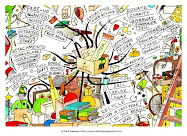
The article below, which made The New York Times list of most-viewed stories, was originally published on June 30, 2008. Take a look at these highly-recommended foods. (And many thanks to Daughter Number Three for the image assembling them: something to post on the refrigerator?)
We actually do surprisingly well with these at our house. I often add a can of pumpkin to soup or make pumpkin bread. I love beets, and roast them at least once a week...looks like it's a good idea to grate some into salads. Sardines make a quick meal or snack, with just whole grain bread or crackers, cheese, and radishes: a great way to get some protein and calcium. (I'm also a big fan of smoked oysters, a source of vitamin A. No cooking necessary with these fish, or with pickled herring or smoked salmon.)
Cinnamon toast is an excellent snack for children (using whole grain bread) – better than cookies, but with a bit of gratifying sweetness.
"Dried plums" is the new name for prunes...now that's a food marketing makeover that risks losing a perfectly good word.
Well: Tara Parker-Pope on Health
The 11 Best Foods That You Aren't Eating
Nutritionist and author Jonny Bowden has created several lists of healthful foods people should be eating but aren’t. But some of his favorites, like purslane, guava and goji berries, aren’t always available at regular grocery stores. I asked Dr. Bowden, author of “The 150 Healthiest Foods on Earth,” to update his list with some favorite foods that are easy to find but don’t always find their way into our shopping carts. Here’s his advice.
- Beets: Think of beets as red spinach, Dr. Bowden said, because they are a rich source of folate as well as natural red pigments that may be cancer fighters.
How to eat: Fresh, raw and grated to make a salad. Heating decreases the antioxidant power. - Cabbage: Loaded with nutrients like sulforaphane, a chemical said to boost cancer-fighting enzymes.
How to eat: Asian-style slaw or as a crunchy topping on burgers and sandwiches. - Swiss chard: A leafy green vegetable packed with carotenoids that protect aging eyes.
How to eat it: Chop and saute in olive oil. - Cinnamon: May help control blood sugar and cholesterol.
How to eat it: Sprinkle on coffee or oatmeal. - Pomegranate juice: Appears to lower blood pressure and loaded with antioxidants.
How to eat: Just drink it. - Dried plums: Okay, so they are really prunes, but they are packed with antioxidants.
How to eat: Wrapped in prosciutto and baked. - Pumpkin seeds: The most nutritious part of the pumpkin and packed with magnesium; high levels of the mineral are associated with lower risk for early death.
How to eat: Roasted as a snack, or sprinkled on salad. - Sardines: Dr. Bowden calls them “health food in a can.” They are high in omega-3’s, contain virtually no mercury and are loaded with calcium. They also contain iron, magnesium, phosphorus, potassium, zinc, copper and manganese as well as a full complement of B vitamins.
How to eat: Choose sardines packed in olive or sardine oil. Eat plain, mixed with salad, on toast, or mashed with dijon mustard and onions as a spread. - Turmeric: The “superstar of spices,” it may have anti-inflammatory and anti-cancer properties.
How to eat: Mix with scrambled eggs or in any vegetable dish. - Frozen blueberries: Even though freezing can degrade some of the nutrients in fruits and vegetables, frozen blueberries are available year-round and don’t spoil; associated with better memory in animal studies.
How to eat: Blended with yogurt or chocolate soy milk and sprinkled with crushed almonds. - Canned pumpkin: A low-calorie vegetable that is high in fiber and immune-stimulating vitamin A; fills you up on very few calories.
How to eat: Mix with a little butter, cinnamon and nutmeg.
You can find more details and recipes on the Men’s Health Web site, which published the original version of the list last year.
In my own house, I only have two of these items — pumpkin seeds, which I often roast and put on salads, and frozen blueberries, which I mix with milk, yogurt and other fruits for morning smoothies. How about you? Have any of these foods found their way into your shopping cart?Tuesday, September 16, 2008
Welcome to Elenabella


I hope you will visit often, as this blog evolves.This past Sunday New York Times had an article about the poet John Ashbery, who at age 81 has prepared his first exhibit of collages. I loved this article for many reasons, not least because Ashbery works with both words and images. And who knew! And 81 years old! And he looks like a sturdy bear in his photo.