Showing posts with label Daughter Number Three. Show all posts

Wednesday, April 28, 2010

Ramp it up for local greens


Daughter Number Three participated in No Impact Week last week, a project of Colin Beavan (author of No Impact Man), described as a "one week carbon cleanse." She wrote about trash, energy use, local food, water conservation, and transportation, warning that it could be TMI week at her blog: the sustainable, like the political, has its highly personal dimension.

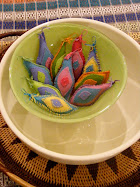
Wednesday, April 21, was Local Food Day, with the challenge to eat only local food. She posted this wonderful photo of ramps from Wisconsin, and confessed to also eating fiddleheads from ostrich ferns (I wonder what those taste like?), and sorrel pesto made from a plant in her yard (sounds delicious). Let's hear it for all the pestos and green sauces: basil, cilantro, parsley, sorrel, thyme, chives, oregano, marjoram, sage, mint. Horseradish greens are also amazing, with a strong spicy taste.

My friend Cheryl reminds me that Barbara Kingsolver's book Animal, Vegetable, Miracle is a great place to read about asparagus and ramps (next up: garlic scapes) as harbingers of spring. I have the book, and that's my sign – time it crack its spine.

I ate ramps, asparagus, and local egg for breakfast: it was divine.

Thursday, March 25, 2010

Color Blind, Blinded by Color: 'The Pink and Blue Project' of JeongMee Yoon


The images here are by JeongMee Yoon, a photographer from South Korea
whose work makes visible the gender divisions that so often prevail in the bedrooms of children from the time they are born. If you search for her name, dozens of pink and blue photos will appear, pictures of children surrounded by possessions in the predominant color of their childhood. These are part of her Pink and Blue Project, which she describes as exploring:
the trends in cultural preferences and the differences in the tastes of children (and their parents) from diverse cultures, ethnic groups as well as gender socialization and identity. The work also raises other issues, such as the relationship between gender and consumerism, urbanization, the globalization of consumerism and the new capitalism.
Yoon explains that The Pink and Blue Project was prompted by her five-year-old daughter "who loves the color pink so much that she wanted to wear only pink clothes and play with only pink toys and objects." She also has an eleven-year-old son, who chooses clothing from the blue hues "even though he does not seem to particularly like the color blue over other colors." A couple of her examples defy the stereotypes but reinforce the idea of having a "favorite color" (one of those ubiquitous questions during childhood): "Lola and Her Yellow Things" and "Steve and His Red Things".

Yoon's work with this concept was the subject of a New York Times piece in February 2008, where the tone is fairly effusive about "the wonderful world of color." (There is a slide show by that name there, too.) A blogpost at Daughter Number Three considers the more invasive implications of gender color-typing. DN3 also links to an interesting post by social psychologist Sam Sommers called "Gender Stereotypes and the Fast Food Drive-Thru." (One more reason to avoid giving your kids this terrible food.)

It all got me thinking about how much energy parents invest in their children's objects and identities, a topic Jesse Ellison touched on in her Newsweek piece, "My Parent's Failed Experiment with Gender Neutrality." Failed? Not so sure. At least her parents resisted the compulsion to crowd out her childhood with one preassigned color. There may be huge intangible benefits to that.


Tuesday, March 23, 2010

Health Care Reform round-up, with a painting by Mira Schor


Daughter Number Three rounded up a few interesting pieces regarding the passage of Health Care Reform, including a link to a post by science fiction and fantasy writer George R.R. Martin, "recounting specific cases of self-employed writers who could not get insurance, writing with anger, grief and relief."

Writer John Scalzi (who is also creative consultant for the television show Stargate: Universe) offers Health Care Passage Thoughts here. He has received 160 comments on that post, which is preceded with a preemptive note about civil commentary:
The Mallet of Loving Correction is in play as of NOW. Please be polite to each other even if you disagree with each other vehemently as to the benefit of the health care bill. Also, just as a general tip, comments that are rhetorically indistinguishable from what they would be if the GOP and the Democrats were merely football teams in the Super Bowl are likely to be mocked by me, if in fact I don’t just delete them for inanity. What I’m saying is be as smart in your comments as I know you can be. Thank you.
Daughter Number Three also tracked down a summary of the new law at Women's Voices for Change, a chart called "How the bill affects you" from The Los Angeles Times and a CNN Money story about how the bill will affect small business.

Here is a look at the 34 democrats who voted against health care reform, from Talking Points Memo, where there are many more relevant bits, including wacky RNC Chairman Michael Steele's comments to Fox News anchor Shepard Smith, captured on video: he agrees with House Minority Leader John Boehner's assertion that health care reform is akin to Armageddon.

On a more positive note: over on facebook, I learned that Annie Corrigan, co-host and producer of the NPR podcast Earth Eats, early morning radio announcer extraordinaire, and oboist (for Pete's sake!) is another one of those ubiquitously creative and hard-working people who has been uninsured. That should change now, and that alone makes me pleased.

New York artist Mira Schor, author of A Decade of Negative Thinking: Essays on Art, Politics, and Daily Life (and painter of the image here) has been posting historic videos about health care to her facebook page, including one of Teddy Kennedy from 1978. Pounding the podium in the name of health care as "a matter of right and not of privilege," Kennedy's comments about his own family's ability to pay for and "receive the very best" point to the disparities that fueled his passion for health care reform. Here is another, even earlier (1974) interview with Edward Kennedy on the topic.

Wednesday, February 24, 2010

Credit Unions offer real money tools


Not all credit cards are created equal. I'm not really in the habit of making financial tips, but I do think there is an art to moving capital through communities to the greater benefit of the common good. Or moving cash through a lifetime to help you make the most of your best opportunities. And now we are swimming in shark-infested waters.

I attended a financial services webinar today, offered by Signal Financial Federal Credit Union, the credit union serving the National Cooperative Business Association (NCBA). The presenter described in detail the advantages of seeking financial services from a credit union, especially in today's economy. Credit unions did not engage in sub-prime mortgage lending, or make wildly speculative investments at the risk of members' deposits. They are in a position to lend, at reasonable rates.

Signal Financial is offering an affinity card with a relatively low APR (6.5%) for the life of a balance transfer, with no balance transfer fees. You must qualify to join, with a $5 deposit to a share (savings) account. This particular affinity card directs 2¢ of every purchase to the Cooperative Development Foundation, a group that helps co-ops in our country and abroad (including cooperative groups in Haiti).

You can contact them directly to find out how to qualify for membership. Signal Financial is networked with other credit unions across the country.

Credit unions are cooperatives guided by the Seven International Cooperative Principles, including education, information, and training. One of the things I appreciate about them is that they usually have someone on staff who gives free financial services advice. They typically offer accounts for children that help kids learn how to manage and save money, too. Here's a neat "Thrive by Five" program for preschoolers over at the Credit Union National Association (CUNA) website. As is so often the case, teaching these principles to kids is not a bad way for adults to absorb them.

Meanwhile, I received an application today for The New Visa® Black Card. Lord knows I don't "deserve" one – they are meant to attract those discerning "individuals" (always that word) who have thousands of dollars of disposable income (read "flush it away") per year, who might find it a privilege (or sign of status) to pay a $495 annual fee. Here are the jaw-dropping terms and conditions for this Black Hole of Debt card. You don't find this kind of language over at the credit union sites, either, by the way:
For those who demand only the best of what life has to offer, the exclusive Visa Black Card is for you. The Black Card is not just another piece of plastic. Made with carbon, it is the ultimate buying tool. 
The Black Card is not for everyone. In fact, it is limited to only 1% of U.S. residents to ensure the highest caliber of personal service is provided to every Cardmember.
That requires some levity. Here, Jon Stewart gives a little lesson about loan sharks (with thanks to Daughter Number Three):

The Daily Show With Jon StewartMon - Thurs 11p / 10c
Make it Rain - Bank of America
www.thedailyshow.com
Daily Show
Full Episodes
Political HumorThe Olympics

Monday, February 8, 2010

Mark Morford on the national mood: "Why are you so terribly disappointing?"


On ranting, rudeness, and the (perceived) national mood, continued.

A column by Mark Morford, called "Why are you so terribly disappointing?," floated onto my facebook page, via writer Katherine Lanpher (author of the memoir Leap Days, and co-host of the The Al Franken Show on Air America Radio in 2004 and 2005).

Morford is a writer and opinion columnist for the San Francisco Chronicle and SFGate; he also teaches Vinyasa yoga in San Francisco. Here are just the second and third paragraphs of the full essay:

What happened to my bonus? What happened to my job? What happened to my country? Why can't it all go the way it's supposed to go? You mean having a kid won't solve my marriage problems? Why don't these drugs make me feel better? Where's that goddamn waiter with my salad? Have you seen the stupid weather today? Is this really all there is?
These are, from what I can glean, the most important questions of the day, of the month, of modern life itself. Hell, what with the economy and job situation, the housing market and the overall feel and texture of the nation right now, it's no wonder Americans are, by and large, a goddamn miserable bunch. We don't like anything right now. No politician, no decision, no situation, no inhale, no exhale. We are sick to death of all of it, including ourselves.
Morford references Joel Achenbach's "The audacity of nope," from the January 27th issue of the Washington Post in that "We don't like anything" observation. It's a column on a distressing subject, but he nails it, and it's funny, and it makes you think. There's a book of more Morford coming soon:

..The Daring Spectacle, a mega-compendium of my finest and most incendiary Chronicle columns and assorted hate mail, banned pieces and related journalistic sacrilege.
 I can't wait. In the meantime, he has a terrific website, complete with a yoga section offering Bliss pictures. (It doesn't disappoint.)

****


Thursday, August 13, 2009

Foreign Icons


No, I'm not talking about rock stars, but rather, the informational signs in places other than our own. Daughter Number Three wrote a post during her Midlife Crisis Tour called Icons of Quebec, collecting drive-by shots of various signs, with observational comments. Included in the collection are this "Chute Fall" sign, as well as the blue one that could be called "Boogie On...and Up This Way." (It's all in the marvelous elbow-knee action.)

I was reminded of a few informational signs I saw during our recent trip to Holland and Germany. I'll gather photos of those together for a post tomorrow. Meanwhile, head over for a glance at some Quebecois icons!

Wednesday, August 12, 2009

Chateau Frontenac in Quebec City


Here's an opportunity for vicarious adventure: Daughter Number Three is just back from a trip to Quebec City, with sisters/Daughters 1, 2, and 4. They took a properly branded Midlife Crisis Tour, complete with themed buttons of DN3's (and her partner's) design.

I thought they were staying at Hogwarts, but it's actually Chateau Frontenac, Quebec City's landmark, overlooking the St. Laurence River. The D-Day invasion was planned there in 1944. (But did the Daughters really stay there? On second thought, I'm not entirely sure. The flowered photo, though, is one of theirs.)

What a world of stories must exist within that hotel! I'll have to show this to Sav's friend Alice, who traveled to Germany and Holland with us in July. She wants to go into hotel management...aim high, Alice! So much more intriguing than a microtel.

Sunday, June 7, 2009

Will Allen of Growing Power


Will Allen, founder and CEO of Growing Power, Inc., won a much-deserved MacArthur Foundation fellowship in 2008. Once a professional basketball player, Allen also worked in corporate marketing at Procter and Gamble before turning his energy to the development of Growing Power, based in Milwaukee, Wisconsin, since 1995.

Allen is a major source of inspiration and information for the urban gardening movement, inspiring people of all ages. He teaches workshops to aspiring urban farmers across the United States and abroad. His passion is for transforming the cultivation, production, and delivery of healthy foods to underserved urban populations.

Allen recognized that many low-income urban populations have very limited access to affordable fresh fruits and vegetables, resulting in health-related problems such as obesity and diabetes. He transplanted the best “back to the land” efforts of the sustainable agriculture movement to an urban garden of under three acres, using raised beds, aquaculture, vermiculture, and compost-heated greenhouses to raise food. He then went to focus on redesigning urban food distribution networks.

Naturally, he's had a huge impact on human culture in the process. Growing Power works because it engages many people through internships, workshops, and intensive, hands-in-the-compost-bin training. The goal is to improve the diet and health of the urban poor, and in the meantime, a whole lot of learning, community building, and creative interaction takes place.

This guy is my hero. A lot of people feel that way – click here for a couple of posts about Growing Power written by Daughter Number Three, from Minneapolis. And here's a piece about Allen from the White House Organic Farm Project. There are a number of Growing Power facebook pages, too, and now they are populating my facebook page!

Friday, June 5, 2009

DN3 on ConAgra's Pirate Food


Run-don't-walk over to Daughter Number Three, to read yesterday's post about Pirate Food. A critique of corporate agribusiness, it began as a response to this hideous (or maybe just dopey) logo, the new mark for ConAgra Foods., Inc.

What the heck is that, I wondered? A pirate? Someone whose eye has been poked out with a spoon? I realized, on one level, it was meant to be a smiley face, but the one-eyed thing was really distracting -- what happened to the other eye? Or was it an asymmetrical cyclops?

DN3 reflects on what this logo suggests about a corporation that proudly devours smaller brands. A bland and tasteless pirate, it seems entirely clueless about current local food trends. With a new tagline, "Food you love," ConAgra Foods Inc. for the first time is overtly advertising its name with the brands it makes (make that "overtakes"). Hmmm. Yumm? Check out this sharp and savvy debunking of their brand strategy, from someone with years of experience in media and natural foods.

There's a photo of ConAgra products sitting on a shelf in a pantry somewhere...straight out of the 70s? I think I cleaned out that cupboard once: I can almost feel the sticky, smudgy dust on those boxes and on the lids of those jars. Oops – stale and outdated...have to pitch them!

Thursday, April 16, 2009

Watching the "Olds" in a Slow Election


To be honest, I haven't watched the news a lot lately. I've been paying attention to other things, averse to the stream of teabag-and-tax outrages over on the telly, where the headers sound more and more like tabloids.

Andreas often calls the news "the olds," and I sometimes have to agree, especially in the case of that molasses-slow election over in the great state of Minnesota.

Here's a firsthand look at the recount, by Jay Weiner (normally – and formerly – a sports writer) from back in December, in the MinnPost. Daughter Number Three, who brought the piece to my attention, describes it like this: "Weiner shares his thought processes as a reporter who's a neophyte at campaign coverage, but an old hand at reporting and covering the Twin Cities." She also posted a link way back in November that lets you see the ballots for yourself, to consider the issues involved in accepting or rejecting them. I've been impressed with the due diligence effort in Minnesota on this, the determination to get it right. (Uff da to all of those archival boxes.)

Give it up, Norm. This is a case of diminishing returns, in which Coleman looks less impressive with each passing day. Millions of dollars and hundreds of hours of dedicated human energy have already been spent on the recount. At this point, polls indicate that the majority of Minnesotans wish Coleman would concede. Time to pack away that archive – perhaps at the Walker Art Center, as an installation of paper that people can walk through, shred, and make into origami peace cranes? Put this particular election to rest.

Sunday, April 12, 2009

Happy Easter with Peeps and Tiny Creatures


Time for a holiday. We have a yard full of blooms now, and the kids are asking for one more Easter egg hunt, Jack's last year in high school. I'll be sending the kids over to Daughter Number Three to see a couple of highlights from the St. Paul Pioneer Press Peeps Video Contest, too. Here are the 302 entries to their Peeps Diorama contest, which you can view as a slideshow. Check those Peeps out (and watch out if you eat them)!

The little butter cream bunny here is from Etsy (of course) – fresh from the shores of Lake Michigan, where it was created by Liz, áká Two Left Hands. An interesting detail: somewhere on TLH's blog she mentions wishing that she could knit or crochet, like her Mom (who also has a shop, ohruthie), but couldn't, so she turned to making unique small sculptures. These include the fairy tale creatures pictured here, and some wonderful monsters. Terrific eye-hand coordination and original design for someone who has "two left hands" – I find her work to be very playful and endearing, with exceptional craftsmanship.

TLH's daughter, Humblebea, has a shop, too, selling handmade children's clothes, and HER son has joined in the fun, selling pocket books from an Etsy address called darksiderules. You can buy his original children's book about a little hamster named Ruby and her best friend Lily.

I'm telling you, people: so much more fun than Walmart or Target. Happy Easter to you and to all of those Michigan family crafters!

Tuesday, March 31, 2009

Sculptural Diversity at Mel Schettl's


Daughter Number Three drove to Mel Schettl's Freight Sales
at Butte des Morts (Hill of the Dead), near Oshgosh, Wisconsin. She sent out a web post with the photos here, of some of the wild things available at Mel's. You'll find this description at RoadsideAmerica.com:

Mel Schettl opened his home improvement business here in 1973. The property that surrounds the building is littered with hundreds of larger-than-life statues: a moose, a bull, a bulldog; King Kong, Bugs Bunny; dinosaurs, mythological creatures; and weird metal sculptures like a robot stegosaurus and a shark on wheels.

"It's something that's just kinda grown," says Mel. "We don't build the stuff. We consign with different artists to build it for us -- fiberglass, steel, glass -- over 200 sculptures so far. Anything to get attention, I guess."

Visitors recommend stopping by at night to better appreciate the creepiness of the place. Says Mel: "Beauty is in the eye of the beholder."

Mel's is an "out-of-mall experience," where you can purchase everything from that large metal dino to close-out kitchen cabinets, a giant fiberglass statue of Michael Jordan, cherry pickers, trailers, military practice bombs – sort of an a(ctual)-bay for random acts of imagination, in two locations. There are Cowboy Days and flea markets, too: it's a genuine amusement park, without the entrance fee. The branding is a little quirky: does the name – Mel Schettl Sales, or Mel Schettl Freight Service – really communicate what the heck this is? Hell, it's Mel!

Which came first, Mel Schettl (from a shtetl?), or kitschy Wisconsin? Is this the origin of those sculptural oddities you see along Interstate 90 around the Wisconsin Dells: the giant moose, the jumbo carp, the gargantuan chunks of fiberglass cheese? And where do people go to learn how to make this stuff? There's a Mel's Flickr stream, too.

I find it interesting that Mel doesn't just buy stuff: he actually commissions and consigns those sculptures, for sale or rent: here's an outlet, perhaps, for out-of-work set designers. He calls his business a "fiberglass petting zoo" but specifies that it's actually a home improvement center. Not a minimalist, Mel, or immaculate gallery owner. If you are in the market for kitchen fixtures, a trip to Mel's would be so much more interesting than Menards. Thanks for the Americana off-road tour to this hill of ghosts and phantasmagoria, DN3!

Saturday, March 28, 2009

Frankenstein and The Happy Sunshine Family


Daughter Number Three recently posted a YouTube video made by her daughter Ruby and her daughter's friend Arielle, called "The Happy Sunshine Family." I've included it here: it's a family romance complete with "wicked" twin locked in a cage, like poor Harry Potter under the stairs at the Dursleys, or the many dogs – wicked or not – who periodically go back to the cage in their owner's homes.

This fascinating, morbid trope goes all the way back to fairy tales, and then to one of the world's most notorious anti-heroes, Frankenstein, patron saint of the misunderstood and encaged/enraged Other.

I read Frankenstein, the novel, for the first time a couple of years ago, and as a result became obsessed with everything having to do with Mary Shelley. This kind of took me by surprise, as I don't consider myself a fan of the horror genre. What intrigued me was the notion of Frankenstein as outsider who wants to become a member of the "happy sunshine family" but who is unequivacably unwelcome to them. Watch the video, and we'll pick up on the comparisons tomorrow. Here is the frontispiece to the original edition of the book.

We were bored, so...... we created a somewhat disturbing movie using playmobiles. Yep.


Sunday, March 22, 2009

Sequestered Newspaper Racks


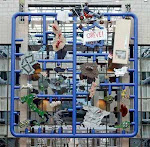
Here is an image of out-of-use newspaper racks, in a storage yard in San Francisco, on Friday March 13th, 2009. It's an AP photo by Noah Berger, one in a series of pictures from the current recession, over at the Big Picture; an editor's note specifies that the unused boxes were removed due to city rules, not because of economic pressures.

Still, it's an image that no doubt made the mix because of the precarious state of the newspaper business. This has been a topic of discussion in many places, including one of my favorite blogs, Daughter Number Three, where the topic is called "newspaper diaspora."

Here is an interesting piece by Walter Issacson, from the Thursday, February 5, 2009, issue of Time magazine: Issacson tracks the ups and downs of various web trends, pointing out that "the bulk of the ad dollars [on the web] has ended up flowing to groups that did not actually create much content but instead piggybacked on it: search engines, portals and some aggregators." He advocates a new, less cumbersome system of micro-payments, directing more income to content providers. It is an interesting suggestion, in an article that may get you searching deeper, clicking over to the 50 best websites of 2008, the 50 best inventions of 2008, Apple's 10 best business moves, and pictures from the recession of 1958. (Just yesterday, by the way, the editor of Time stepped down: magazines are in trouble, too.)

But first, the art: this image drew me in because of both its formal and conceptual properties: the color and configuration of multiple, nearly identical shapes; the topic it suggests (the death of newspaper). Objects often appear more abstract when clustered (like buckets hanging from a tree); it's a color field with its own formal beauty. Who invented the newspaper rack as an object, anyway? (Like a plastic or metal tv screen on every street corner.) What are those city rules pertaining to them? And whatever happened to the newspaper boy?

Museums are important because ideas reside there, on every flat surface, in each installation. What happens to newspaper racks if they are piled in a room in a contemporary museum? I imagine that they would spark thoughts ranging from city rules to the state of print journalism to the economies of art. What would it take for an artist to claim and redistribute these racks? What happens to their value if they become sculpture? Or if an artist like Walter Lab, who sees the potential for beauty in trash, flattens and turns them into a painting?

Sunday, January 18, 2009

As Newspapers D/evolve


I grew up in a family where, like clockwork, my father fetched the Minneapolis Star Tribune from the front stoop first thing in the morning. He then carried it to the kitchen table, where a little territoriality about various sections would ensue. Dad, and then the rest of us, would spend breakfast reading, expressing disgust or delight (most often the former) about something going on in the world. On week-end mornings especially, spirited conversations would take place about all manner of random topics: look at this brilliant cartoon! I can't believe Ann Landers said that! Why do the Vikings so rarely win? Will the Viet Nam war ever be over? Doesn't this "Mall of America" sound preposterous? Have you seen the review for the new play by Theatre de la Jeune Lune?

The Strib, which in better days was run by John Cowles Jr. (and founded by his grandfather) has recently filed for bankruptcy. John Cowles Jr. sat on the boards of directors of the The Associated Press and Columbia University's Pulitzer Prizes; he and his wife, Sage Cowles, have contributed immeasurably to the quality of life in the Twin Cities, elevating the level of dance, the arts, and discourse about philanthropy. They are Hill Fellows at the Hubert H. Humphrey Institute of Public Affairs. I'd love to know their views about the devolution of newspapers as purveyors of culture and information.

Daughter Number Three recently asked the question What Will You Miss About Newspapers?, echoing a post by marketing guy/"guru" Seth Godin (on January 14) called When Newspapers Are Gone, What Will You Miss? Godin's provocative-yet-blithe remarks (he won't miss much, and seems blasé about the demise of journalism) were picked up by Cory Doctorow over at Boing Boing, where they inspired a long, insightful comment thread.

Several writers talked about how newspapers helped them learn to read. Comment #2, posted by Robbo, reminds me a bit of my own experience:

When we were kids we'd all scramble over the various sections of the evening paper (The Telegram - now defunct) and hunker down on the floor of the living room to read. A lot of my early reading experience was gathered with the paper - starting with the comics - all emulating our father and poring over the wall of words spread out before us. Dinner would be ready and we'd all troop to the table - comparing black ink stained elbows as trophies of how much we had captured from those pages. Maybe when they come up with a touchscreen carpet that sensation of physical immersion in the media will return. That's what I would miss - the physical relationship with the paper - and the ink.

Other people noticed that Godin underestimates the effort and cost of quality news writing. This paragraph, with its focus on "magical economics," struck me (and others at Boing Boing) as just plain wrong:

The reality is that this sort of journalism is relatively cheap (compared to everything else the newspaper had to do in order to bring it to us.) Newspapers took two cents of journalism and wrapped in ninety-eight cents of overhead and distraction. The magic of the web, the reason you should care about this even if you don't care about the news, is that when the marginal cost of something is free and when the time to deliver it is zero, the economics become magical. It's like 6 divided by zero. Infinity.

Journalist Joshua Ellis took up the issue in a piece called "What Newspapers Are For" at his Work blog, Zen Archery:

But it’s not free. I can’t understand why people don’t see this. Writing an article about corruption in local or national politics is not free. It takes time and money to make it happen — more time and money than this blog post took, or Godin’s post took, enough time and money that most people can’t afford to do it simply for whuffie or blogerati status. Delivering it may be free and instantaneous, but that doesn’t mean making it is free and instantaneous. In this sense, the economics truly are magical, in the sense that most of the people attempting to practice them are making an extremely artful show out of smoke and mirrors. And the miracles are just as illusory.

This is a fascinating subject for those of us who are "content providers." It makes me want to sit in on a journalism class, to see how students and professors are sorting this out. How do they reimagine the career path that still makes way for quality news writing, going beyond the vagaries of attitude and opinion we click through in all of these blogs?

I tend to see this not as a case of either (newspapers) or (the Web), but both of these and other emerging and electronic communications, like video and tv. The carrier changes, but we still try to protect and enhance the quality of the news.

Andreas prefers to call it "the olds." Okay, off to bring in the Sunday New York Times, which I appreciate in both newsprint and on-line versions.

Thursday, January 15, 2009

Add these to your diet


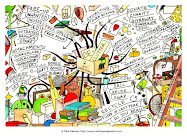
The article below, which made The New York Times list of most-viewed stories, was originally published on June 30, 2008. Take a look at these highly-recommended foods. (And many thanks to Daughter Number Three for the image assembling them: something to post on the refrigerator?)

We actually do surprisingly well with these at our house. I often add a can of pumpkin to soup or make pumpkin bread. I love beets, and roast them at least once a week...looks like it's a good idea to grate some into salads. Sardines make a quick meal or snack, with just whole grain bread or crackers, cheese, and radishes: a great way to get some protein and calcium. (I'm also a big fan of smoked oysters, a source of vitamin A. No cooking necessary with these fish, or with pickled herring or smoked salmon.)

Cinnamon toast is an excellent snack for children (using whole grain bread) – better than cookies, but with a bit of gratifying sweetness.

"Dried plums" is the new name for prunes...now that's a food marketing makeover that risks losing a perfectly good word.

Well: Tara Parker-Pope on Health
The 11 Best Foods That You Aren't Eating

Nutritionist and author Jonny Bowden has created several lists of healthful foods people should be eating but aren’t. But some of his favorites, like purslane, guava and goji berries, aren’t always available at regular grocery stores. I asked Dr. Bowden, author of “The 150 Healthiest Foods on Earth,” to update his list with some favorite foods that are easy to find but don’t always find their way into our shopping carts. Here’s his advice.

  1. Beets: Think of beets as red spinach, Dr. Bowden said, because they are a rich source of folate as well as natural red pigments that may be cancer fighters.
    How to eat: Fresh, raw and grated to make a salad. Heating decreases the antioxidant power.
  2. Cabbage: Loaded with nutrients like sulforaphane, a chemical said to boost cancer-fighting enzymes.
    How to eat: Asian-style slaw or as a crunchy topping on burgers and sandwiches.
  3. Swiss chard: A leafy green vegetable packed with carotenoids that protect aging eyes.
    How to eat it: Chop and saute in olive oil.
  4. Cinnamon: May help control blood sugar and cholesterol.
    How to eat it: Sprinkle on coffee or oatmeal.
  5. Pomegranate juice: Appears to lower blood pressure and loaded with antioxidants.
    How to eat: Just drink it.
  6. Dried plums: Okay, so they are really prunes, but they are packed with antioxidants.
    How to eat: Wrapped in prosciutto and baked.
  7. Pumpkin seeds: The most nutritious part of the pumpkin and packed with magnesium; high levels of the mineral are associated with lower risk for early death.
    How to eat: Roasted as a snack, or sprinkled on salad.
  8. Sardines: Dr. Bowden calls them “health food in a can.” They are high in omega-3’s, contain virtually no mercury and are loaded with calcium. They also contain iron, magnesium, phosphorus, potassium, zinc, copper and manganese as well as a full complement of B vitamins.
    How to eat: Choose sardines packed in olive or sardine oil. Eat plain, mixed with salad, on toast, or mashed with dijon mustard and onions as a spread.
  9. Turmeric: The “superstar of spices,” it may have anti-inflammatory and anti-cancer properties.
    How to eat: Mix with scrambled eggs or in any vegetable dish.
  10. Frozen blueberries: Even though freezing can degrade some of the nutrients in fruits and vegetables, frozen blueberries are available year-round and don’t spoil; associated with better memory in animal studies.
    How to eat: Blended with yogurt or chocolate soy milk and sprinkled with crushed almonds.
  11. Canned pumpkin: A low-calorie vegetable that is high in fiber and immune-stimulating vitamin A; fills you up on very few calories.
    How to eat: Mix with a little butter, cinnamon and nutmeg.

You can find more details and recipes on the Men’s Health Web site, which published the original version of the list last year.

In my own house, I only have two of these items — pumpkin seeds, which I often roast and put on salads, and frozen blueberries, which I mix with milk, yogurt and other fruits for morning smoothies. How about you? Have any of these foods found their way into your shopping cart?

Saturday, January 10, 2009

Congrats to the new Seward Co-op


Seward Co-op Grocery and Deli opened on the morning of January 8th in a new location: 2823 East Franklin Avenue, Minneapolis, Minnesota. The new store is the result of more than three years of planning and effort on the part of the co-op board, staff, and members.

Daughter Number Three was on hand when the new doors opened; she shot this camera phone photo of the excited crowd. She has collected information about the project in a post to her site, where there is also a link to a flickr stream of photos. This one, of Seward general manager Sean Doyle and former board president Dan Nordley (Chief Park Ranger at Triangle Park Creative) comes from that stream.

Past GMs P.J. Hoffman, Stuart Reid, and Gail Graham were on hand to help celebrate; all of them continue to do critical work in the world of food co-ops. Dave Gutknecht was there too; he's the editor of Cooperative Grocer.

I also found a report about the store, in advance of its opening, at a blogsite called The Deets, by Ed Kohler. That's where I got this work-in-progress outside pic. I like the modern look of the exterior: "We are Green and Proud, have you noticed!?"

It's another great achievement in the world of food co-ops, not least in that hotbed of crunchy organic food, Minnesota. Congrats to the community of Seward Co-op!

Friday, December 5, 2008

Discover Magazine on Race, Revisited


I follow a blog by Daughter Number Three which you can find on the left and click into directly. She describes it as "a filing cabinet of stuff I've stumbled across. But you can't keep everything."

DN3 works in media and is a sociologist by temperament and training, bringing that sensibility to her work. She has a lot of good stuff in that filing cabinet, but what's most interesting is the critical sensibility she brings to it.

DN3 recently reopened the November 1994 Discover magazine, an entire issue devoted to the best scientific thinking on race at that time, called "Race: What Is It Good for? Science looks at flesh and bones, genes and behavior."

In her own words (below), Daughter Number Three describes her decision to archive and disseminate the articles in this issue of Discover. The pieces are very interesting, and I encourage you to go over to her site to take a look. She also mentions the fact that the cover of that issue (shown here) was stunningly unattractive, as have been (in my view) those composite images this year where the faces of various candidates have merged and melded. (Actually, this HillaryBarack one is growing on me...)

I was very taken with most of the stories, and put the entire issue into the filing cabinet. From time to time, I check Discover's website to see if they have put this content online, but to date, they have not.

Recently, I decided I would scan the text and run it through OCR software so it can be found on the web. I realize this is a copyright violation, but it's one of those things that no one is reading currently because it's not online. (Yes, you could find it as a bound hard copy in some libraries, if you went looking for it. But these days, doesn't that seem so... difficult?)

If they want me to take it down, I will, and if they want my version to post on their site, they're welcome to it.
So here goes. I'll post the articles over the next few days as I get them cleaned up.