Monday, January 18, 2010

In Dreams Begin Responsibility: Martin Luther King Day 2010


Reiko Eoh's cartoon commentary on Martin Luther King Day 2010 reminds me of the phrase "In dreams begins responsibility," used as an epigraph for William Butler Yeats' poem "Responsibilities 1914" (and attributed, mysteriously enough, to simply an "Old Play").


The phrase is sometimes quoted as "In Dreams Begin Responsibilities," the title of a frequently anthologized short story by Delmore Schwartz. In one of the PBS American Masters series documentaries, the rock musician Lou Reed (a former student of Schwartz), talks about the influence the poet and writer had on him as an artist. Reed calls it "the best short story I'd ever read."


I haven't yet read it, but would like to now. Wikipedia summarizes this way:


The story tells of an unnamed young man who has a dream that he is in an old-fashioned movie theater in 1909. As he sits down to watch the film, he starts to realize that it is a motion picture documenting his parents' courtship. The black-and-white silent film is of very poor quality, and the camera is shaky, but nonetheless he is engrossed. Soon the young man starts to get upset. He yells things at the screen, trying to influence the outcome of his parents' courtship and the other people in the audience begin to think he is crazy. Several times the character breaks down. In the end he shouts at his parents when it appears they are going to break up, and he is dragged out of the theater by an usher who reprimands him. The animadversion is important to the story, as it reveals a bit of the character's insecurity. In the end, the character wakes up from his dream and notes that it is the snowy morning of his twenty-first birthday.


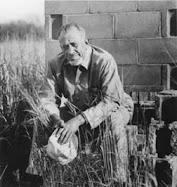
(Schwartz's own parents divorced when he was nine, an event that is said to have had a profound impact on him.) LOVE this pic of Delmore at an angle in his chair, with all those books at angles and odds, too. And this other photo of him with his bookish cohort.


 Here is Yeats' poem:


"In dreams begins responsibility."

                   Old Play.


"How am I fallen from myself, for a long time now
I have not seen the Prince of Chang in my dreams
."

                           Khoung-fou-tseu.
PARDON, old fathers, if you still remain
Somewhere in ear-shot for the story's end,
Old Dublin merchant "free of ten and four"
Or trading out of Galway into Spain;
And country scholar, Robert Emmet's friend,
A hundred-year-old memory to the poor;
Traders or soldiers who have left me blood
That has not passed through any huxter's loin,
Pardon, and you that did not weigh the cost,
Old Butlers when you took to horse and stood
Beside the brackish waters of the Boyne
Till your bad master blenched and all was lost;
You merchant skipper that leaped overboard
After a ragged hat in Biscay Bay,
You most of all, silent and fierce old man
Because you were the spectacle that stirred
My fancy, and set my boyish lips to say
"Only the wasteful virtues earn the sun ";
Pardon that for a barren passion's sake,
Although I have come close on forty-nine
I have no child, I have nothing but a book,
Nothing but that to prove your blood and mine
.

January 1914.


That's a long way from Martin Luther King's "I Have a Dream" speech, and from the headaches facing Obama. The common theme? Something to do with legacy, with the traces of history inherited from one's forebears. The specific challenge of shouldering the burden of "the dream," in all of its ambiguity. The film of the past ("screen memories," as Freud would describe them) that affect our Ability to Respond. The sense of "falling from oneself." The desire to affect both chance and change, and to avoid squandering energy on barren passions.


As Martin Luther King, Jr. put it in a letter from the Birmingham jail:

"We must use time creatively, in the knowledge that the time is always ripe to do right."


Sunday, January 17, 2010

Print Magazine: Obsessions and Information Processing

One of my favorite websites is that of Print magazine, a publication now celebrating 70 years. The tagline: Design for Curious Minds. (Love that.)

The magazine itself is beautiful – a model of interesting, clean design, with current examples of outstanding magazine, book, and print design, articles exploring the history of print, and news about conceptual and technological trends. But here's is how the editors describe it (they do a better job):

Print is a bimonthly magazine about visual culture and design. Founded in 1940 by William Edwin Rudge, Print is dedicated to showcasing the extraordinary in design on and off the page. Covering a field as broad as communication itself—publication and book design, animation and motion graphics, corporate branding and rock posters, exhibitions and street art—Print covers commercial, social, and environmental design from every angle. Engagingly written by cultural reporters and critics who look at design in its social, political, and historical contexts, Print explores why our world looks the way it looks, and why the way it looks matters.

At the website, you only get a teaser about the current issue: the magazine has a life of its own (and you can buy back issues). You do get other features, though, including an Image of the Day archive. As I write, here is the current image:


(Nice. They seemed to know it would go with my elenabella header.) There are videos, live feeds, resources for artists, and links to wonderful blogs, including The Daily Heller by Steven Heller of the School of Visual Arts, where the feature today is "Could It Be Any Worse for Magazines?" He uses this image from a doctor's office to consider the further doom of magazines. (God forbid that they remove them from the waiting room. Cancel my annual appointments, please.)


There's also a weekly feature called Obsessions by Patric King, owner and principal at House of Pretty, Ltd. in Chicago. I found the article on January 11th to be especially interesting, as it may read as an explanation (to someone like Declan Kiberd) of how visual types process information. It's an answer to the final paragraph quoted in Kiberd's review yesterday, about the folly of sensory overload.

King talks about multi-tasking in the context of a book given by his mother:

...the thing that really caught my interest was the note Mom sent along with it: “Keep this where you’ll browse it idly.” 

So genius. Mom knows I’m a multi-tasker, one who reads while watching television and listening for email, instant messenger, Facebook, and Twitter notifications. She also knows how I learn: I watch a lot of information channels as a first pass, marking things I want to read later. On a second pass, I read deeper, marking items again. On a third pass, an item becomes a subject for research and I Google it to death.

Since Mom understands how I ingest information, she simply told me to keep the book by the living room TV where I can open it anywhere, browse, and begin adding its pages to my filtration method. She didn’t tell me to read it in a disciplined way; she knew that would never happen. Being a retired teacher with some teaching of gifted classes under her belt, she knew to just toss it out there and let it work. How interesting that there are many different methods of learning at our disposal that we may not have thought to use.

Saturday, January 16, 2010

Declan Kiberd on the Lure of Books: (Re)reading with Eileen Battersby

Everyone should have at least one friend who vigorously resists contemporary modes of communication, yet remains connected in profound and genuine ways. For me, that friend is Declan Kiberd, professor of English at University College Dublin. He doesn't have email, certainly doesn't twitter, and (according to his daughter Amy) "will NEVER submit to a mobile!" Phone, that is. I think he writes his many books in a longhand scrawl, covering legal pads with carefully formulated observations. If you write him a letter, and send it by post, he just might write back – if you have something meaningful to say. The entire world seems to interest him.

("You won't find him surfing the Internet," says Amy. "He calls it a 'download.'")


I wrote about Declan last March 18th, after the amusing experience of finding a facebook page dedicated to a Declan Kiberd Appreciation Society. Needless to say, he does not do facebook. (Here's a post about Kiberd at Anderson Brown's Literary Blog, a link picked up at that facebook page.) But he does write sometimes for The Irish Times, and today this review came my way, via Serial Susan, via Richard Rose, via baseball writer Ann Bauleke (author of "The Puckett Principle").

In this review, Kiberd looks at Second Readings 52: From Beckett to Black Beauty by Eileen Battersby (Liberties Press). A voracious and enthusiastic reader, Battersby looks back at 52 books she first encountered at a younger age. Kiberd writes:

FIRST IMPRESSIONS are lasting, but second readings can transform a person from one imprisoned by an experience to one who can contain and even transcend it. That is a central intuition of psychoanalysis. Revisiting a past moment, at which a life may have got snagged, allows a person to live more fully through the missed elements of that moment and then to move on.

There is another kind of second reading too, which allows us to experience all over again a feeling of unqualified pleasure. If every book is in some way a second reading of a life, then the great novels of the world capture that life most abundantly.

A piece of music can suddenly restore for us the lost world in which we first encountered it, and so also can a book. But to that recaptured experience is added a deeper consciousness of its meaning over time, along with a tender sense of the innocence of our initial responses.

Of nothing may this be more true than of books. CS Lewis once said that a story worth reading at the age of 10 will also be worth rereading at the age of 50. In that later venture, it is our prior selves, as well as the text, that we reread. And what we find is how deeply, at all stages, it has been reading us.

The final thought is this one:

What is even more admirable is that, unlike so many people who read nowadays solely for exam courses or for other practical purposes, she reads for pleasure – in story, in shaped sentences, in the magic of a word or an image. It’s more than 70 years since Walter Benjamin wondered whether the children of the future would enjoy “the exacting silence of a book”. Since then a whole generation has been turned outward, away from interior exploration, by iPods, Playstations and MTV. Some can’t even contemplate writing an essay without the sound of music or the flicker of images in the background. There is something faintly scandalous and wonderfully anachronistic about Ms Battersby’s pursuit of literary pleasure in a culture too often characterised by a search for mere sensations.


I'm passing this along like a lucky chain letter: Read this review and you might just be inspired to (re)read 2 to 52 books in the next year: that could certainly change your life. Connect with story the old-fashioned way, with that hand held device once known as a book.

Friday, January 15, 2010

On the Freezer Doors at the Food Co-op: Man Makes Use of Plants and Animals

We sometimes talk about the Theater of Food in food co-ops, and in the kitchens of small cafés. The show must go on, through all kinds of weather, political crises, personal dilemmas. There is always a lot happening behind the scenes, as in any theater. In the morning, the vegetables are put out on display like gigantic live sculptures, and the meat and deli cases are restocked. The grocery shelves are fronted and faced; the morning muffins start baking before the sun comes up. Phone calls are made to source local and organic products: tofu, grass-fed meats, wild seafood, morels, watercress, organic dairy. (Wo)Man Makes Use of Plants and Animals, indeed.


I love food co-ops because they provide jobs with benefits to talented people who enrich their communities in multiple ways. They are independent-minded souls. Many also excel as musicians, writers, mothers and fathers, midwives, artists, community volunteers, green builders, students, teachers, healers, tattoo-artists, massage therapists, master gardeners, local growers, videographers, dancers, business entrepreneurs. They are very community-minded and tend to be active in local politics. Nerds, geeks, back-to-the-landers, hipsters – they resist such delimiting designations (or embrace them ironically), tending to run the individuality gamut. Most like people and thrive on teamwork. They make good stagehands, extras, soloists, stand-up comedians, set painters, wine tasters, and go-to-guys and gals. Lots of them are really good cooks. They've discovered natural foods and as a result they don't spend a lot money on junk food or pharmaceuticals. They span a wide age range, too, making this an inter-generational drama.


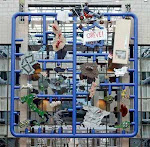
These vintage schoolbook images decorate the freezer walk-in doors at the Bloomingfoods Near West Side location. Just a little glimpse of the set design (and the wit) backstage.


Thursday, January 14, 2010

Up and Coming, Up and Running: Food Co-op Start Up Conference

We're having a conference here in Bloomington, on February 19 and 20, for people who are working to start food co-ops in their communities. I am on the board of the Indiana Cooperative Development Center, and on the staff of Bloomingfoods: both organizations are teaming up, with help from the Cooperative Development Foundation, to offer this opportunity. The more food co-ops, the better! (I am a co-op evangelist, I know..)

I just finished designing the Save the Date card, and the Conference Schedule. Come join us if you want to team up with your friends and neighbors and start your own grocery store!


Wednesday, January 13, 2010

A Yellow Table, from Queen Brown

There are not enough hours in the day...at least that's how I feel today. A conversation at work about the need to try to scale back on multi-tasking. Focusing is so indescribably delicious, when one is given the chance.

So I need to keep things simple today. I found a beautiful drawing made years ago by a woman named Queen Brown, a daytime resident of the Willows Care Center in St. Paul, Minnesota, where I had the privilege of teaching an art class for elderly participants. This was sponsored by COMPAS, an extraordinary organization that has offered meaningful community arts opportunities to countless people over the years.


Queen would focus intently, talking only once in awhile. She had a regal bearing, just like her name, and took a great deal of pride in her images. They came out of her, from her long thin graceful gnarled hands, one patient and deliberate gesture at a time. This yellow table, with its embellished hem, never fails to fill me with a kind of calm satisfaction. Trying to remember to channel Queen.

Tuesday, January 12, 2010

"The Tree of Life" by Peter Sís

Author and illustrator Peter Sís has written a children's book about Charles Darwin called 'The Tree of Life'. Follow the link to see an animated excerpt. Like many children's books, it's a good place for adults to learn, too. The cover of the book is especially beautiful. Many thanks to Serial Susan for sending me to his work.


This lovely website includes a Tibetan maze, with more than one pathway to the butterfly in the center. See if you can find your way there!

Monday, January 11, 2010

Something to Make: Gift Boxes

While my cake was baking I looked at the mix box and decided to cover it with colored paper. Now it makes a  reusable (and reusable again) gift box. I used a heavy textured double-sided paper – it doesn't wrinkle, and completely covers the images on the box. These can be purchased in a stack and are surprisingly inexpensive...much less than the same amount of gift wrap. Now the box works for a book, or any number of other small gifts. (Like this book, with a packet of seeds..)


Next I covered a pot pie box. I found an old collection of scrap paper tucked away in a box of its own and (this is the uncanny part) the image on that box is a green Darwinian Tree of Life, surrounded by creatures of many kinds. That's a nice little echo, given my recent interest in Darwin. (I covered that box many years ago: can you sense a bit of an obsession?)


It's easiest to cover a box if you carefully take it apart and flatten it, reassembling it after the glue dries. I used plain white tacky glue (colle inélégante). The pot pie box has a nice piece of silver paper inside that can also be used to add a decorative touch. Now if I could just figure out what to do with that pot pie pan...Incense burner, suggests my friend Kim. (It appears to be fire resistant). Or a place to park a gluey brush when making projects..
 

Sunday, January 10, 2010

Going to the Movie with Marie: Nine Thoughts about 'Nine'

Encouraged by my sister-in-law Rozie, I went with my friend Marie to my first movie house movie in a long time: Rob Marshall's 'Nine,' a film about a musical about Fellini's '8 1/2.' I had a few amorphous thoughts, which I'll try to contain within nine comments:

1. Anthony Lane wrote a review in The New Yorker on December 21st: he makes some very good points, but he's a lackluster audience member, as he gives away in his comments about Marshall's 'Chicago.' Some people just don't like musicals. I'm on the fence; I love their potential. 'Chicago' was quite wonderful, I thought (to my surprise). I did come away from both 'Chicago' and 'Nine' with some vivid impressions and respect for the effort of these films. And I kept singing "Be Italian, be Italian" last night, until my family asked me to stop. That song has a nice Threepenny Opera-like edge.

2. As I told Marie, I liked the movie better than the title. It's a tricky one. I can see why they chose it, but it's not ideal for bringing in an audience. It signals the fact that the pleasures (or perhaps the disappointments) of viewing this movie are intensified the more you read it in relation to '81/2.' 'Nine' is linked to and dependent on 81/2 (with its vita-pointing title); it's a supplement, homage, interpretation. The next number down the line is 'Nine.' So at it's best, like Bruce Springsteen's 'Seeger Sessions,' it also points audiences in the direction of great art of the past.

3. It's been years since I watched Fellini movies, but they are going straight up to the top of my Netflix queue, beginning with '81/2,' which received an Academy Award for Best Foreign-Language Film in 1963.

4. Lane complains that the film is a "hymn to regret," as if it could be something else. Despite the number of women in the cast, all showering forms of attention on film director Guido Contini (Daniel Day Lewis), the story concerns amorous and artistic anxiety. Guido loses the love of his wife (the remarkable Marion Cotillard), and withdraws from celebrity in order to try to regain it. He needs to regain artistic integrity, too, away from the pressures of the producer and the public. Lane makes a good point: Love is in the service of art, and we tend to see that as monstrous (as does Guido's wife).

5. This is a film for Tiger Woods to have watched over his lonely Christmas holidays. 'Nine' is a visual reversal of 'Ocean's Eleven,' all about variety among these many powerful females: the muse (Nicole Kidman), the mistress (Penelope Cruz), the wife (Cotillard), the confidante (Judi Dench), the tease (Kate Hudson), the Mama (Sophia Loren), and the elemental sex goddess (okay, the whore – Fergie). It is least convincing when it showcases them on a black backdrop (as in Cruz's steamy dance scene). There are awkward breaks between staged moments and storied ones – always a challenge in a musical film. Yet it makes sense that some of the larger numbers take place on a stage, calling attention to the genre of burlesque entertainment, the only place where some of the emotions in the film can be emphatically broadcast and universalized. Cotillard's black-and-white rage and revenge performance in a night club is extraordinary.

6. The movie reminds me of 'Mad Men,' my favorite television show. I like the fact that both efforts involve paying attention to the ingenuity and eroticism of a bygone era. They also concern a hero who is both attractive and conflicted, whose biggest problems are clearing some path to his own solitude, managing the advances of appealing women, and trying to rekindle his creative drive. (He's suffering from 'directile dysfunction,'  quips Variety).

7. The paparazzi were born in Italy, right? In fact, according to Wikipedia, the word 'paparazzi' is an eponym originating in the 1960 film La dolce vita directed by Federico Fellini. The film contains a lot of visual Fellini-esque pleasures, not least being the the evocative black and white sequences, little vintage sports cars, the white sun-drenched seaside spa, and the narrow streets near the squalid pensione where Contini parks his desperate mistress. The costumes are glorious. Judi Dench plays Contini's costume mistress  and I completely suspended my disbelief to think that SHE had created these outfits, including the gorgeous wool coat she wears in a scene near the end of the movie, walking with Guido along a river in (I think it was) Milano.

8. Movies on this theme don't play so well today. We are tired of hearing about the haunted genius who must keep all of his women in their limited roles, who loves them each so long as they meet the needs of some compartmentalized part of himself, who cannot be satisfied no matter what he is given. There is a nice scene with Nicole Kidman which looks directly at our impatience with this old story. (She takes Guido's hat and says "I'd rather be the man.") Kidman is wearing a fabulous golden white dress,  and looks very Bridget Bardot; Marie and I thought we'd never seen her more radiant.

Our heroes today are vampires and werewolves who fight each other to prove how loyal they can be to one specific female, even if they have to love her from a distance; they can't be intimate without transforming or killing the object of their desire. They are monster men who have the self control to not seize and destroy their women. (This has its downside, too.)

9. Marie said as we left the theater: "I don't care, if it comes to choosing between watching Daniel Day Lewis and watching George Clooney, I would choose Daniel every time. Yes, George is cute, too. In fact they could just make a movie called 'Two' starring the two of them, and I would be happy." So despite the fact that the film focuses on many expressive and desiring dancing females (in a range of emphatic amorous and anguished poses), it is Guido the camera loves most. "Presumably this is a movie for women, right?" asks Marie. The men we know are all going to 'Avatar' instead (and most of the women, too). Not that there's anything wrong with that – but this is trying to be adult entertainment (in all senses of the phrase) about men at mid-life and the women they need to fuel their energies, enact their fantasies. (Here's a review from the UK Telegraph, as well as one from Moviefone.)

Here's a trailer. There's another at You Tube with Kate Hudson's dance to 'Cinema Italiano': an homage to her mother Goldie Hawn, in her go-go girl days.


Saturday, January 9, 2010

Recipe for a Snowy Day: Sweet Sorghum Clabbered Banana Bread

One of the things I like about shopping at the co-op is that we carry local items that can't be found anywhere else, except at farmers markets. Last month, just out of curiosity,  I picked up a jar of pure cane sorghum from Lynd Creek Sorghum Mill in Orleans, Indiana. I had never thought much about sorghum before, though at one time it was the most exported agricultural product in the state. (I heard that fact from a check-out clerk, so check it out with more research if you don't believe us.)

There are many sweeteners besides highly processed white sugar and high fructose corn syrup. Believing sugar to be the most pernicious of the nutritional poisons, I like investigating these.

So as I write, I am baking some Sweet Sorghum Banana Bread. I have to take down the recipe here, so I won't forget it – I'm improvising a bit.

Ingredients:

2 cups of flour, mixing whole wheat and unbleached white to your liking (I go heavy on the whole wheat)
1 1/2 teaspoons baking powder (mine is Clabber Girl, from Terre Haute, Indiana)
pinch of baking soda (about 1/4 teaspoon)
1/2 teaspoon salt
1 cup mashed banana (about 3 medium very soft bananas: I freeze mine and then let them thaw)
1/2 cup organic apple sauce (or apple blackberry, apple apricot: I use Santa Cruz Organic applesauce or any homemade variety) * Adding some apple sauce let's you reduce the amount of butter or oil, and adds a more complex fruit flavor.
1/3 cup sorghum syrup
1 tablespoon honey
2 eggs
1/3 cup buttermilk or yogurt (if you are out of both of these, use milk to which you add a teaspoon of vinegar or lemon)
1/4 cup softened butter (Earth Balance Buttery Spread if you are vegan, or coconut butter if you like a hint of coconut taste in your banana bread)
1/3 cup roasted and chopped walnuts

1. Preheat oven to 350•F. Butter the inside of a loaf pan.
2. Combine the flour, baking powder, baking soda, and salt in a bowl and mix well.
3. Combine the mashed bananas, sorghum syrup, honey, butter, eggs, and buttermilk. Beat with a mixer at a medium speed until blended. Add flour mixture and beat at low speed until evenly blended. Stir in the walnuts with a wooden spoon. Pour into pan.
4. Bake 60 minutes or until a knife inserted in the center comes out clean. Cool in the pan on a wire rack for 15 minutes. Remove from pan and finish cooling on the rack. Tastes great warm!

Okay, I just tasted it: this is rocking good banana bread! Not too sweet, but rich and nutritious.


If you don't know what "clabber" is, you are in luck here today. The Clabber Girl in Germany would be the Quark Girl, and in France she'd be the Creme Fraiche Girl. (Though those two clabbered creams taste somewhat different to me.) Clabber is one of those lovely food products that all but disappeared in the United States with the advent of pasteurization. Here's the scoop from our many friends at Wikipedia:

Clabber is a food produced by allowing unpasteurized milk to turn sour at a specific humidity and temperature. Over time the milk thickens or curdles into a yoghurt-like substance with a strong, sour flavor. In rural areas of the Southern United States, it was commonly eaten for breakfast with brown sugar, nutmeg, cinnamon, or molasses added. Some people also eat it with fruit or black pepper and cream. Suitable fruits include apples and bananas.
Clabber was brought to the south by the Scots-Irish (also known as the Ulster-Scots) who settled in the Appalachian mountains. In fact, clabber is still sometimes referred to as bonny clabber (originally "bainne clábair", from Gaelic bainne - milk , and clábair - sour milk). [1] Clabber passed into Scots and Anglo-Irish meaning wet, gooey mud, though it is commonly used now in the noun form to refer to the food or in the verb form "to curdle". A German version is called Quark. In France a similar food made from cream is known as Crème fraîche.
With the rise of pasteurization the making of clabber virtually stopped, except on farms that had easy access to unprocessed cow's milk. A somewhat similar food can be made from pasteurized milk by adding a couple of tablespoons of commercial buttermilk or sour milk to a glass of milk.

And, wouldn't you know: there's a version of Clabber that is a trick-taking card game, a variation of Euchre played mostly around Evansville, Indiana. (How's that for a local mutation?) Pass the deck of cards, and the banana bread!


Friday, January 8, 2010

Snow Days, Welcomed Slow Days


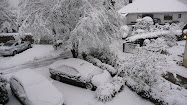
It's been a long time since we've had this kind of snowfall in south central Indiana (someone said a decade) – many inches of the kind of soft powder that makes people pull out their long-forgotten cross country skis. Savannah spent two days sledding with high school friends, little kids again. Jack is on a bus back from a long-anticipated week of skiing in Aspen; he may be bummed to learn that he missed a couple of days of spectacular powder here.


For me, it mostly looked peaceful and beautiful. Weclomed snow slow days. I took a few photos of the snow on trees in our yard, hunkered down to focus on various projects, and listened to the beautiful silence.


John Cage talked about everything as music: sounds heard. (I know this thanks to my brother, John.) I thought about that while shoveling the driveway. In the distance – a neighbor at the same task. A nice percussive sound, and because the snow was so light and easy to deal with, not a lot of cussing to accompany the shovel.


Thursday, January 7, 2010

Serial Readers Discuss 'Wives and Daughters'

My friend Serial Susan writes a blog called Serial Readers. This is an excellent place to engage in an on-going web-based book group, with guidance from a scholar. Susan David Bernstein’s (English) research and teaching focus (at the University of Wisconsin Madison) is on Victorian literature and culture, nineteenth-century transatlantic literature, as well as feminist theory and women’s writing. She's also co-taught a course on Darwin, but more on that another day.

The blog features chapter-by-chapter entries, calling attention to themes and interesting bits of the current book. Comments come from other dedicated readers. You can jump in back where the entries for a particular book began, and hasten to catch up.


Right now the serial readers are immersed in Wives and Daughters, a wonderful novel (or "every-day story") by Elizabeth Gaskell, first published in the Cornhill Magazine from August 1864 to January 1866. When Mrs. Gaskell died suddenly in 1865, the book was incomplete; the last section was written by Frederick Greenwood. The story revolves around Molly Gibson, only daughter of a widowed doctor living in a provincial English town in the 1830s.

There's a link at Serial Readers to a piece about web-based novels, or wovels. Making me wonder, will that irksome-yet-clever word also catch on?

Wednesday, January 6, 2010

Away in a Manger: the Quirky Creche

I have always been enchanted by the fact that Jesus was born in a manger (did I mention that I was a home birth mom?). Perhaps it's the mental merging of the home birth experience with a love for diverse small farms...or something like that. One of my favorite children's books is Who is Coming to Our House?, by artist Ashley Wolff. She uses a linoleum block technique to illustrate Joseph Slate's story of animals anticipating the birth. Christ's name is never even used (though Joseph's and Mary's are): "Who is coming to our house?" "Someone, someone," says mouse. It is subtle and somehow more awe-some.


It's soon time to pack away the little array of Christmas decorations we have our on our sideboard. I decorated our little Hoosier cabin to make a quirky creche. Christ observes his own swaddling self from the vantage point of both childhood and young manhood, alongside other guests.


I was at the home of Malcolm Dalglish and Judy Klein the other day  – for years, with their daughters Naomi and Mia, they've created a mossy creche at the base of their gloriously old-fashioned Christmas tree. There are a couple of nuns standing at a respectful distance from the babe, and a Mexican women's chorus singing nearby, as well as a large rooster observing from a branch of the Christmas tree. Here is the scene, enhanced for a few numinous effects, including a multiplied, more emphatic, choral ensemble.(And I love the ghostly praying squirrel.)


Here's another sweet moment in their tree: a little Hickory bark skier. (And many thanks to Judy for coining the word "diversitrees" in relation to Susan Bee's paintings, and pointing out that this, too, is one.)


Tuesday, January 5, 2010

Diversity Trees from Susan Bee (Diversitrees)

While reading Charles Darwin, I find myself thinking about those Trees of Life. I really love what I'm calling "diversity trees," created by artist Susan Bee – paintings with many surprises in the branches. I wonder if she thought about Darwin at all when developing her tree-tropes.

They make me wonder: what sort of objects and items live on my diversity trees? Divinity trees. Trees of natural and not-so-natural selection.

What lives on yours?

Here is In a Medieval Garden:


And here is Butterfly Boy Drawing, which I currently use as wallpaper on my laptop.


Ice Cream seems relevant, too. (This appears to be a body-image piece, with ice cream in an ambivalent role):


Aren't they amazing? Here's another, from a cover of Fox, a collection of poems by Adrienne Rich:


Monday, January 4, 2010

Darwin Tattoos and the Tree of Life


Darwin is famous for his Tree of Life hypothesis, and we talked yesterday about how his ideas predict the science of ecology (here is that Wikipedia definition):

Ecology (from Greek: οἶκος, "house" ; -λογία, "study of") is the interdisciplinary scientific study of the interactions between organisms and their environment.[1] Ecology is also the study of ecosystems. Ecosystems describe the web or network of relations among organisms at different scales of organization. Since ecology refers to any form of biodiversity, ecologists can conduct research on the smallest bacteria to the global flux of atmospheric gases that are regulated by photosynthesis and respiration as organisms breath in and out of the biosphere. Ecology is a recent discipline that emerged from the natural sciences in the late 19th century. Ecology is not synonymous with environment, environmentalism, or environmental science.


The only image in the original On the Origin of Species is a tree diagram representing Darwin’s model for the theory of evolution. It looks like this (kind of like a musical score):


The first draft of his Tree of Life is a sketch in the little black notebook B (now at Cambridge University), from July 1837. The text reads:


I think

Case must be that one generation then should be as many living as now. To do this & to have many species in same genus (as is) requires extinction.

Thus between A & B immense gap of relation. C & B the finest gradation, B & D rather greater distinction. Thus genera would be formed. — bearing relation (page 36 ends - page 37 begins) to ancient types with several extinct forms.


And here is that sketch on the body of a contemporary Darwin devotee (below), found at the site of Michael D. Barton ("Darwin's bulldog," writing from Bozeman, Montana), Dispersal of Darwin. Looks a bit like a wound with stitches.


There are many more Darwin tattoos, including those over at the Discover blog. Here's an impressive one of  the portrait variety: "Got it at Darwin City Tattoos, in Darwin, Australia. The artist is Blue aka Mat Selwyn."


Sunday, January 3, 2010

Turnspit Dogs, from On the Origin of Species


I finally read (most of) On the Origin of Species, by Charles Darwin, and this afternoon gathered with a group of women friends to discuss it. We ate baked apples, roasted sweet potatoes, deliciously flavored onion rings, and other things – and compared our thoughts about this extraordinary work, which most of us (college graduates all) had never previously read.


In preparation, I watched a Nova special called What Darwin Never Knew, a very helpful update focusing on the impact of "the world's biggest idea" (evolution) on the birth of modern science and its many branches. We are now 200 years after Darwin's birth and 150 since the first publication of Origin


There were a few exclamation marks in the margins. We noted this disturbing anthropological observation: "We see the value set on animals even by the barbarians of Tierra del Fuego, by their killing and devouring their old women, in times of dearth, as of less value than their dogs."


But it was the turnspit dog that most made us sit up and bark. The reference is in Chapter One, "Variation Under Domestication." Here is an example of Darwin's prose:


One of the most remarkable features in our domesticated races is that we see in them adaptation, not indeed to the animal's or plant's own good, but to man's use or fancy. Some variations useful to him have probably arisen suddenly, or by one step; many botanists, for instance, believe that the fuller's teasel, with its hooks, which can not be rivalled by any mechanical contrivance, is only a variety of the wild Dipsacus; and this amount of change may have suddenly arisen in a seedling. So it has probably been with the turnspit dog; and this is known to have been the case with the ancon sheep. But when we compare the dray-horse and race-horse, the dromedary and camel, the various breeds of sheep fitted either for cultivated land or mountain pasture, with the wool of one breed good for one purpose, and that of another breed for another purpose; when we compare the many breeds of dogs, each good for man in different ways; when we compare the game-cock, so pertinacious in battle, with other breeds so little quarrelsome, with "everlasting layers" which never desire to sit, and with the bantam so small and elegant; when we compare the host of agricultural, culinary, orchard, and flower-garden races of plants, most useful to man at different seasons and for different purposes, or so beautiful in his eyes, we must, I think, look further than to mere variability. We can not suppose that all the breeds were suddenly produced as perfect and as useful as we now see them; indeed, in many cases, we know that this has not been their history. The key is man's power of accumulative selection: nature gives successive variations; man adds them up in certain directions useful to him. In this sense he may be said to have made for himself useful breeds.

We found more on turnspit dogs in Wikipedia (of course) with this image from "Notes on a Tour to North and South Wales," published in 1800. And here's a taxidermied turnspit ("the last remaining example") found at the blog Scribal Terror.


The Turnspit Dog is a short-legged, long-bodied dog bred to run on a wheel, called a turnspit or dog wheel, to turn meat. The type is now extinct. It is mentioned in Of English Dogs in 1576 under the name Turnespete. Rev. W. Bingley's Memoirs of British Quadrupeds (1809) also talks of a dog employed to help chefs and cooks. It is also known as the Kitchen Dog, the Cooking Dog, the Underdog and the Vernepator. In Linnaeus's 18th century classification of dogs it is listed as Canis vertigus. The breed was lost since it was considered to be such a lowly and common dog that no record was effectively kept of it. They are related, it is believed, to the Glen of Imaal Terrier.

The Vernepator Cur was bred to run on a wheel in order to turn meat so it would cook evenly. This took both courage (to stand near the fire) and loyalty (not to eat the roast). Due to the strenuous nature of the work, a pair of dogs would often be worked in shifts. This may have led to the proverb 'every dog has his day.' The dogs were also taken to church to serve as foot warmers. One story says that during service at a church in Bath, the Bishop of Gloucester, gave a sermon and uttered the line "It was then that Ezekiel saw the wheel...". At the mention of the word "wheel" several turnspit dogs, who had been brought to church as foot warmers, ran for the door.


Human ingenuity never ceases to amaze me. Will we bring some kind of turnspit animal back?


Saturday, January 2, 2010

Internal Audio Sound Trek Helps Repel Invader

Christian Briggs posted this as his sound theme for 2010, noting how music from the Amok time fight scene in Star Trek played in his head as he rapidly calculated how to best discourage a violent encounter with someone "a few fries short of a happy meal" on the first morning of the new year. ("Before coffee," no less.)

A PhD candidate in Human-Computer Interaction Design and Complex Systems at Indiana University (and co-founder of Social Lens, a research and advisory group), Briggs then wrote a Public Service Announcement on Home Invasions about the experience. It contains sage advice about deterring encounters of the unwelcome kind – you can find it at the link. Read it and maybe rethink those open doors.

Friday, January 1, 2010

Face-to-face(book), and Dinner for One


Today the sun is shining – last night, the big blue (most impressive) moon.

We ushered in the new year without the playbills but with the poems, taking seats on the floor at a pilaf party with doggerel recited to shots of vodka. Glad to be over the 00-s/ooze, the oughts/naughts, on to the teens (in time) and what they may bring. My friend Marie penned a poem while seated on the couch, something like: "20 of us here, but we all have lots more friends – 2009 was the year of facebook: the friendship never ends." A brilliant take on facebook and the face-to-face.

Meanwhile, my brother sent me this riff on the ritual of toasting: Dinner for One, a black-and-white British slapstick sketch, mostly unknown in the English-speaking world, but now a New Year's Eve ritual as the highest-rated TV show in German history. 

The video, shown for the past 45 years on German television, is described as "a silly moment of merriment that has become enshrined in the nation's psyche." Who knew?


Thursday, December 31, 2009

Happy New Year: Here Comes 2010~!


Making stock and taking stock...the last few hours of 2009. I realize that I miss the daily practice of writing for elenabella.

So I'm renewing my commitment to writing here again, after a long hiatus. It's a new year, a new decade, and time to return to the biologue/blog.

Making Hoppin' John and Collard Greens for a party tonight, using a variation of the recipe found at Mac and Cheese. It's written from a vegetarian/vegan point of view; my version includes some local bacon. For greens, I used collards and beet greens. Loved the idea of adding vinegar (I used raw apple cider vinegar), tamari, and hot sauce.

A lot of contentment in the kitchen. I consider myself fortunate whenever I make a bean broth...so delicious. Vegetable scraps go into the freezer for the next batch. Prosperity means a batch of beans and greens: I like that.

Happy New Year! Here comes 2010...

Saturday, September 19, 2009

Elenabella is one year old


Hello! I can't let the clock strike midnight without noticing that elenabella was one year old this past Wednesday...begun on a whim one year ago, September 16th, 2008. It has been a fascinating process to be involved with this blog, and I intend to continue, despite these occasional lapses. So interesting – the lapses...the gaps...and then the intense involvement again with the daily practice.

I'm going to create a little "rhyme in time" and include the first image ever posted to this site, of my little crossword puzzle vase, the first effort of this writing/observing/and making things project. And here is John Ashbery's "Chutes and Ladders," as brilliant as ever.

Anyway, if you have been a regular reader, or even an occasional one, thank you for being my Always Already Ideal Reader, and for visiting (or even commenting) now and then!

Wednesday, September 2, 2009

Travels with Charley, and John Steinbeck


I haven't yet read John Steinbeck's Travels with Charley: In Search of America, but I love the (fiercely romantic) language I found on a friend's facebook info page, under favorite quotes:

For I have always lived violently, drunk hugely, eaten too much or not at all, slept around the clock or missed two nights of sleeping, worked too hard and too long in glory, or slobbed for a time in utter laziness. I've lifted, pulled, chopped, climbed, made love with joy and taken my hangovers as a consequence, not as a punishment. I did not want to surrender fierceness for a small gain in yardage...

The next passage in my journey is a love affair. I am in love with Montana. For other states I have admiration, respect, recognition, even some affection, but with Montana it is love, and it's difficult to analyze love when you're in it.

Steinbeck wrote the book about a road trip he made in 1960, with his French standard poodle Charley, in a specially-made camper named Rocinante, like Don Quixote's horse. The trip covered nearly 10,000 miles. I think it's a book for Mad Men's Don Draper. (I still need to read The Grapes of Wrath, too.)

Tuesday, September 1, 2009

Good Grief: the Pole Dancer Doll


Another trashy toy directed at children. (And purchased by, well – who buys this crap!?) Somehow, she doesn't seem out of place at a store like Toys "R" Us. No doubt she's made of toxic materials, too.
So many toxic toys out there, made by children for children (or made by mothers trying to feed their children), offering profits to people with no shame and no taste. She's a poor little soul killer doll.