Here is an image of out-of-use newspaper racks, in a storage yard in San Francisco, on Friday March 13th, 2009. It's an AP photo by Noah Berger, one in a series of pictures from the current recession, over at the Big Picture; an editor's note specifies that the unused boxes were removed due to city rules, not because of economic pressures.
Still, it's an image that no doubt made the mix because of the precarious state of the newspaper business. This has been a topic of discussion in many places, including one of my favorite blogs, Daughter Number Three, where the topic is called "newspaper diaspora."
Here is an interesting piece by Walter Issacson, from the Thursday, February 5, 2009, issue of Time magazine: Issacson tracks the ups and downs of various web trends, pointing out that "the bulk of the ad dollars [on the web] has ended up flowing to groups that did not actually create much content but instead piggybacked on it: search engines, portals and some aggregators." He advocates a new, less cumbersome system of micro-payments, directing more income to content providers. It is an interesting suggestion, in an article that may get you searching deeper, clicking over to the 50 best websites of 2008, the 50 best inventions of 2008, Apple's 10 best business moves, and pictures from the recession of 1958. (Just yesterday, by the way, the editor of Time stepped down: magazines are in trouble, too.)
Here is an interesting piece by Walter Issacson, from the Thursday, February 5, 2009, issue of Time magazine: Issacson tracks the ups and downs of various web trends, pointing out that "the bulk of the ad dollars [on the web] has ended up flowing to groups that did not actually create much content but instead piggybacked on it: search engines, portals and some aggregators." He advocates a new, less cumbersome system of micro-payments, directing more income to content providers. It is an interesting suggestion, in an article that may get you searching deeper, clicking over to the 50 best websites of 2008, the 50 best inventions of 2008, Apple's 10 best business moves, and pictures from the recession of 1958. (Just yesterday, by the way, the editor of Time stepped down: magazines are in trouble, too.)
But first, the art: this image drew me in because of both its formal and conceptual properties: the color and configuration of multiple, nearly identical shapes; the topic it suggests (the death of newspaper). Objects often appear more abstract when clustered (like buckets hanging from a tree); it's a color field with its own formal beauty. Who invented the newspaper rack as an object, anyway? (Like a plastic or metal tv screen on every street corner.) What are those city rules pertaining to them? And whatever happened to the newspaper boy?
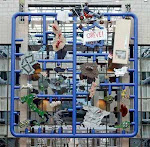
Museums are important because ideas reside there, on every flat surface, in each installation. What happens to newspaper racks if they are piled in a room in a contemporary museum? I imagine that they would spark thoughts ranging from city rules to the state of print journalism to the economies of art. What would it take for an artist to claim and redistribute these racks? What happens to their value if they become sculpture? Or if an artist like Walter Lab, who sees the potential for beauty in trash, flattens and turns them into a painting?
Museums are important because ideas reside there, on every flat surface, in each installation. What happens to newspaper racks if they are piled in a room in a contemporary museum? I imagine that they would spark thoughts ranging from city rules to the state of print journalism to the economies of art. What would it take for an artist to claim and redistribute these racks? What happens to their value if they become sculpture? Or if an artist like Walter Lab, who sees the potential for beauty in trash, flattens and turns them into a painting?


































.jpg)

















.jpg)