Showing posts with label No Impact Man. Show all posts

Wednesday, April 14, 2010

No Impact Week begins on April 18th

There's a No Impact Week coming up, starting Sunday April 18th. I won't be able to participate this week (I have some exciting travel plans that coincide exactly with the challenge), but I'll be watching the blog when I return, and will probably try it week after next.

I know that for me this experiment will work much better as a result of having seen the film No Impact Man, so if you are interested in the challenge, I'd recommend starting there. Once you register, which you can do from a link at Colin Beavan's blog, you'll be able to download ("but don't print out") a guide to five daily steps, with a page of ideas and resources to help you with that day's challenge.

Day one, Sunday, is a reflection on consumption. To kick off, the project recommends watching Annie Leonard's video The Story of Stuff. That's another thing I've wanted to do. One nifty aspect of No Impact Week is that it rounds up resources you can explore in blog-space conversation with a cohort of others engaged with the project. There are some face-to-face events in New York City, and you can become a local No Impact ambassador in your own community too.

Cool! Regarding consumption: one thing I started to do this past January was aim for at least four Buy Nothing Days per week. This is an interesting way to develop awareness about spending. When tempted to buy something, anything (even an apple) I weigh it against the thrill of adding another Buy Nothing Day to my calendar.

I try to cluster shopping trips onto particular days, making it easy to then track purchases. For example, I might go to the co-op for groceries on a day when there is a farmers market next to it, so I can consolidate my shopping. I'll try to fill the car with gas that day too. If I'm aiming to Buy Nothing for five more days, I'll be more conscious of how much gas I'm using, cutting back on aimless or extraneous trips. This is a great way to curtail impulse purchases of all kinds, creating more consciousness around spending.

Just a statistic from The Story of Stuff, found in the No Impact Week guide: "Ninety-nine per cent of the stuff we harvest, mine, process, transport – ninety-nine per cent of the stuff we run through this production system is trashed within six months." Can this really be true? It's a shocking statistic. Every little bit less is something I can easily buy into.

Sunday, April 11, 2010

No Impact Man has big ripple effects


Just home from two screenings of No Impact Man, the film featuring the "no impact family" of Colin Beavan, Michelle Conlin, and their endearing, adaptable daughter, Isabella. If you read my post of the other day, you'll know I was somewhat apprehensive about the eco-extremity of this project: a year of only locally grown food, no electricity, no public transportation, no toilet paper, and so on – from the heart of New York City, no less.

It's a wonderful movie, and I'll make a few observations and comments.

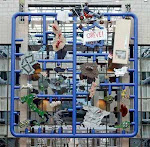
First, the toilet paper. I don't think it's as hard as one would think to make a switch to something else. I just searched for more about cloth toilet wipes, and found a good post from way back in 2006, at Walk Slowly Live Wildly (where I found the photo on the right). No Impact Man doesn't dwell much on the issue of toilet paper, though it shows the couple speculating about the implications of going without, feeling uneasy about assumptions people may make about hygiene. It's the lack of toilet paper that got picked up as a headliner in the New York Times when the No Impact project was publicized there. (I guess the family's solution involved only water and air drying.)

The film doesn't talk much about the family dog, so I was curious about the experiment with regard to pet ownership. It was a great project to undertake with this particular two-year-old, an amenable child who demonstrates wonderful flexibility. The scene when Beavan explains to Isabella that they will not be using toilet paper is worth the price of admission – a lovely inversion of the conversation most parents have with kids of that age.

I was relieved to see them ease into the project in phases, waiting a while to turn out the lights. Both parents struggle with the project and discuss it in revealing, honest conversations. Michelle's ambivalence is very understandable and her story holds the film together; she comes to find more value than expected in the changes that occur as the year goes by. She talks about how long the days become once the lights are out and the air conditioner off in summer, and she huddles under the covers in winter, reading by candlelight. She looks forward to story time with her daughter again, aided by a bedside lamp.

The film made me think about how I washed all of my clothes for one year in the bathtub in Ireland, stomping on them much as the family does in this show, and hanging them on wooden racks, where they would dry slowly over a number of days. (Hanging them outside on the clothesline on the roof resulted in coal-speck-covered clothes that were dirtier than before.) I huddled under the comforter, too, heating one room at a time.

Beavan is so committed to the project, without being too overbearing, and there is a bit of play in their no impact "system", humanizing the film. They are not purists, but are giving us an intimate glimpse of the messiness of their lives. Their apartment appears somewhat chaotic, with books piled high on the shelves. They aren't minimalists living an inaccessible aspirational life, but parents with work to do and the complications of competing desires.

The couple negotiates and explores the value of their decisions, showing us both frustration and joy. They aren't prescribing specifics so much as challenging us to imagine different, more creative ways to live, whether in a large city or elsewhere. It's a great test of both object and human relations, showing the unexpected benefits that may occur with a conscious step away from excessive consumption. The project asks us to ask: what do we truly want and need?

Tuesday, April 6, 2010

The Eco-Extremity of 'No Impact Man'


I have to admit, I've been somewhat skeptical about No Impact Man: the movie, the book, the blog, the hefty no-impact apparatus. Maybe it's the hype about the Prada-loving wife. Maybe it's apprehension about people who seem too eco-aggressive (while their egos are clearly high impact). Nonetheless, I'm curious. So I helped arrange a special screening next Sunday, at the Buskirk-Chumley Theater here in Bloomington, Indiana.

I haven't yet seen the movie, but it has gotten a good bit of attention, with more screenings this month around Earth Day. Lower impact lifestyles are all the rage right now – but what does it feel like to really adopt one? Are they sensible, or simply sensationalist?

Whether you are eco-conscious or just eco-anxious (or in a state of eco-denial) you might also be curious about Colin Beavan, a self-described “liberal schlub who got tired of listening to himself complain about the world without ever actually doing anything about it.”

Several years ago, in November, 2006, Beavan began a year-long “No Impact Project” in which he, his wife Michelle Conlin, and his then two-year-old daughter (and their four-year-old dog) went off the grid, attempting to live in the middle of New York City with as little environmental impact as possible.

No Impact Man tells the story of that year: its challenges, humorous moments, and the difficult choices demanded by a lower impact lifestyle. The rules of the game were: no more electricity, no more automated transportation, no more non-local food, no more conspicuous consumption. (There’s even something in there about toilet paper.) Begging the question: can you do this kind of thing without driving yourself or your family crazy?

The goal was to attract broad public attention to a range of pressing environmental issues – food system sustainability, climate change, water scarcity, and materials and energy resource depletion. 

If you’ve ever wondered how far your should stretch your own lower-impact efforts (or rolled your eyes when a relative or friend suggested using a solar oven instead of the gas grill), you might enjoy this vicarious plunge into eco-extremity.

No trash, no toxins in the water, no elevators, no subway, no product packaging, no air-conditioning, no television...the list goes on. You can learn more about how the family is living today at Beavan’s blog. And if you live in or near Bloomington, please join me on Sunday April 11 at the BCT! (Special pricing for members of Bloomingfoods.)