Showing posts with label John Cage. Show all posts

Friday, January 8, 2010

Snow Days, Welcomed Slow Days


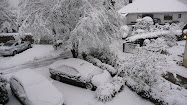
It's been a long time since we've had this kind of snowfall in south central Indiana (someone said a decade) – many inches of the kind of soft powder that makes people pull out their long-forgotten cross country skis. Savannah spent two days sledding with high school friends, little kids again. Jack is on a bus back from a long-anticipated week of skiing in Aspen; he may be bummed to learn that he missed a couple of days of spectacular powder here.


For me, it mostly looked peaceful and beautiful. Weclomed snow slow days. I took a few photos of the snow on trees in our yard, hunkered down to focus on various projects, and listened to the beautiful silence.


John Cage talked about everything as music: sounds heard. (I know this thanks to my brother, John.) I thought about that while shoveling the driveway. In the distance – a neighbor at the same task. A nice percussive sound, and because the snow was so light and easy to deal with, not a lot of cussing to accompany the shovel.


Thursday, April 9, 2009

Don't Take the Diet Too Seriously: John Cage's 27 Sounds in the Kitchen


My brother's birthday two days ago
got me thinking about the composer John Cage. There are quite a few good videos of Cage on You Tube, and after watching a few, this is the one I selected for you: 27 sounds manufactured in a kitchen. Cage was an early Western adopter of a macrobiotic diet (following John Lennon and Yoko Ono) and he talks about that here, in an endearing way.

(No matter how many times I watch this, it always makes me laugh at the end. Whatever diet you follow, don't take the diet too seriously... and pay attention to the sounds you manufacture in the kitchen!)

There's also a 9:22 video of Cage on the tv show I've Got a Secret in January 1960, performing "Water Walk." At the time, he was teaching Experimental Composition at New School in New York City. He uses 5 radios in the piece, but wasn't able to turn them on because of a labor dispute about which of two unions should be allowed to plug in the radios (a detail that seems to please him, and he adapts, slapping the radios instead). The very end of the spot has some fun graphics advertising a companion show of that era, What's My Line? (I have to wonder if Betty and Don Draper, from Mad Men, caught John Cage on I've Got a Secret. My guess is that Bets would find it silly, or annoying – those damaged radios! – whereas Don might be intrigued, taking a long draw on his cigarette before wincing and smiling and packing some idea away in his ad man head.)

There's also a very cool film clip, from Dreams that Money Can Buy, a movie by Hans Richter, with a Marcel Duchamp film fragment (complete with a nearly-nude descending a staircase) and music by John Cage. Somehow these early avant garde pieces still seem relevant and compelling today. It's that uncanny mix of nostalgia for something that happened before my time (so that I missed it at its "moment") and the discovery of how fresh and forward-thinking the experimentation still feels. It's interesting to think about how artists keep playing with the same tropes and obsessions, in various media configurations. For Duchamp it was (partly) the nude, but a "new nude," a very conceptual one.

If you click on the Duchamp link above, you'll find a timeline that includes his Rotary Demisphere, the device used for the optical spheres in Dreams that Money Can Buy. You'll also see the 1941 Box in a Valise, the portable museum of Duchamp's works, reproduced in miniature as if for a salesman's briefcase. 20 copies were created; I saw one at the Text/Messages: Books by Artists show at the Walker Art Center last December. There's also a preview of The Quick and The Dead exibition (next spring) with an interview called "Simon Starling: Tiepolo and Duchamp."


Tuesday, April 7, 2009

Happy Birthday, John!


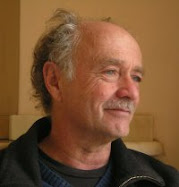
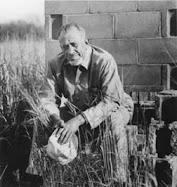
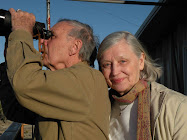
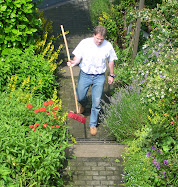
It's the birthday of my brother John Kennedy, of Santa Fe New Music, father of Jasmine and Jade, husband of Rozella, sister to Kathy in Australia, and only son of Joyce and Wally. Here he is on the North Shore of Lake Superior, swimming in the Temperance River.

Does your head swim? That's one of my favorite questions, perhaps because mine so often does, swimming or cascading with memories, images, sounds, and ideas. Cascades: it's a word for a musician like John, someone who hears things.

1. A waterfall or a series of small waterfalls over steep rocks.
2. Something, such as lace, thought to resemble a waterfall or series of small waterfalls, especially an arrangement or fall of material.
3. A succession of stages, processes, operations, or units.
4. Electronics: A series of components or networks, the output of each of which serves as the input for the next.
5. A chemical or physiological process that occurs in successive stages, each of which is dependent on the preceding one, and often producing a cumulative effect: an enzymatic cascade.

John has done many remarkable things, not least of which is the pulling-out-of-thin-air of musical concerts and compositions year after year, first with Essential Music in New York City, and now with Santa Fe New Music in New Mexico. He also organizes and conducts the Music in Time series at the Spoleto Music Festival in Charleston, South Carolina.

If you are new to the sounds of New Music (not to be confused with New Age Music), the Santa Fe New Music site is a good place to learn: you'll find archives, a page with links to the composers featured over their first seven concert series, and a "listen up" list of recommended CDs. John has been influenced by the aleatoric or "chance" music of John Cage, whose memorial service he organized as a musical tribute (with Merce Cunningham, Yoko Ono, and others) in New York City.

You can hear clips from John's own One Body here (click on "Listen to Samples" under the CD cover): it's a composition featuring poetry by Joy Harjo, Gary Snyder, Kenneth Patchen, Walt Whitman, and others, set for the unique voice of countertenor/baritone Bruce Rameker. (Amazon has Rameker incorrectly listed as composer.) Here is more information about One Body, and the libretto. The beautiful CD cover is by painter Nancy Ortenstone, of Taos, New Mexico.

I can't listen to One Body without it bringing tears to my eyes, recalling the way my brother helped "conduct" the recovery of our father, Wally, when he ended up (almost by chance) in an intensive care unit a few years ago. John came to spend days and nights in the unit, watching the machines with intense sensitivity and intelligence, talking quietly with the night nurses. He was adept at tuning us into those moments when Dad needed us to talk to him, and he lead us in the reiki that helped prep him for the surgical procedure that saved his life. At night, in the background, this music played, providing comfort and connection for Wally. Listen to One Body, especially if you are in need of healing: it has great spiritual power.
Much love and gratitude to John on this day!