Showing posts with label Declan Kiberd. Show all posts

Tuesday, April 27, 2010

Mint sauce, like poetry, deserves a revival


Okay, folks – here is more about mint sauce, from our friends at Wikipedia. I am determined to place it on the table, as did Seamus Heaney's mum. With a bit of local lamb, or some new spring peas. Notice the line here about how this sort of sauce "became less common and mostly died out as Europe entered the Modern Era." (That's anything after the Middle Ages, apparently.)

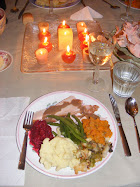
I did have mint sauce at Sunday dinners in Ireland with Eithne and Fred Kiberd, parents of Declan, Damian, and Marguerite. Eithne, like Heaney's mother, would have known and been able to perpetuate the secrets of an older way of life, one that included an admiration for all that rife mint.

I just planted six kinds of mint a weekend before last, purchased at the beautiful expanded garden center at the East Bloomingfoods. Now I have a chokecherry bush waiting for a bit of digging. Here are 10 Essential Herbs to Grow.

This is what I love about Heaney: there is always both a poetic and a practical application to his lines, appealing to the eager part of the mind, as well as to the digger's hunched rump.

•••

Mint sauce is a sauce made from finely chopped mint leaves, soaked in vinegar, and a small amount of sugar. Occasionally, the juice from a squeezed lime is added. The sauce should have the consistency of double cream. In UK and Irish cuisine it is traditionally used as a complement to roast lamb (but usually not other roast meats) or, in some areas, mushy peas. Mint sauce can sometimes be used in recipes in place of fresh mint. For instance, it can be added to yoghurt to make a mint raita. "Sweet and sour" sources such as Mint sauce, and Cranberry sauce were common throughout Medieval Europe, (with the use of mint being more common in French and Italian cuisine of the period than that of the English [1]), however they became less common and mostly died out as Europe entered the Modern Era[2] [3].

References

  1. ^ The Medieval Kitchen: Recipes from France and Italy by Odile Redon, Françoise Sabban, Silvano Serventi, translated by Edward Schneider, University of Chicago Press, 2000, ISBN 0226706850, 9780226706856, page 107
  2. ^ http://www.practicallyedible.com/edible.nsf/pages/medieval!opendocument&startkey=medieval
  3. ^ Cooking in Europe, 1250-1650 by Ken Albala, Greenwood Publishing Group, 2006 ISBN 0313330964, 9780313330964, page 15

External links

This condiment-related article is a stub. You can help Wikipedia by expanding it.

Sunday, January 17, 2010

Print Magazine: Obsessions and Information Processing

One of my favorite websites is that of Print magazine, a publication now celebrating 70 years. The tagline: Design for Curious Minds. (Love that.)

The magazine itself is beautiful – a model of interesting, clean design, with current examples of outstanding magazine, book, and print design, articles exploring the history of print, and news about conceptual and technological trends. But here's is how the editors describe it (they do a better job):

Print is a bimonthly magazine about visual culture and design. Founded in 1940 by William Edwin Rudge, Print is dedicated to showcasing the extraordinary in design on and off the page. Covering a field as broad as communication itself—publication and book design, animation and motion graphics, corporate branding and rock posters, exhibitions and street art—Print covers commercial, social, and environmental design from every angle. Engagingly written by cultural reporters and critics who look at design in its social, political, and historical contexts, Print explores why our world looks the way it looks, and why the way it looks matters.

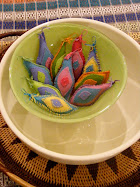
At the website, you only get a teaser about the current issue: the magazine has a life of its own (and you can buy back issues). You do get other features, though, including an Image of the Day archive. As I write, here is the current image:


(Nice. They seemed to know it would go with my elenabella header.) There are videos, live feeds, resources for artists, and links to wonderful blogs, including The Daily Heller by Steven Heller of the School of Visual Arts, where the feature today is "Could It Be Any Worse for Magazines?" He uses this image from a doctor's office to consider the further doom of magazines. (God forbid that they remove them from the waiting room. Cancel my annual appointments, please.)


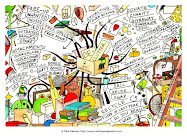
There's also a weekly feature called Obsessions by Patric King, owner and principal at House of Pretty, Ltd. in Chicago. I found the article on January 11th to be especially interesting, as it may read as an explanation (to someone like Declan Kiberd) of how visual types process information. It's an answer to the final paragraph quoted in Kiberd's review yesterday, about the folly of sensory overload.
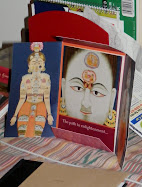
King talks about multi-tasking in the context of a book given by his mother:

...the thing that really caught my interest was the note Mom sent along with it: “Keep this where you’ll browse it idly.” 

So genius. Mom knows I’m a multi-tasker, one who reads while watching television and listening for email, instant messenger, Facebook, and Twitter notifications. She also knows how I learn: I watch a lot of information channels as a first pass, marking things I want to read later. On a second pass, I read deeper, marking items again. On a third pass, an item becomes a subject for research and I Google it to death.

Since Mom understands how I ingest information, she simply told me to keep the book by the living room TV where I can open it anywhere, browse, and begin adding its pages to my filtration method. She didn’t tell me to read it in a disciplined way; she knew that would never happen. Being a retired teacher with some teaching of gifted classes under her belt, she knew to just toss it out there and let it work. How interesting that there are many different methods of learning at our disposal that we may not have thought to use.

Saturday, January 16, 2010

Declan Kiberd on the Lure of Books: (Re)reading with Eileen Battersby

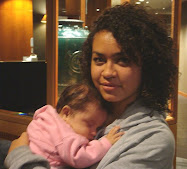
Everyone should have at least one friend who vigorously resists contemporary modes of communication, yet remains connected in profound and genuine ways. For me, that friend is Declan Kiberd, professor of English at University College Dublin. He doesn't have email, certainly doesn't twitter, and (according to his daughter Amy) "will NEVER submit to a mobile!" Phone, that is. I think he writes his many books in a longhand scrawl, covering legal pads with carefully formulated observations. If you write him a letter, and send it by post, he just might write back – if you have something meaningful to say. The entire world seems to interest him.

("You won't find him surfing the Internet," says Amy. "He calls it a 'download.'")


I wrote about Declan last March 18th, after the amusing experience of finding a facebook page dedicated to a Declan Kiberd Appreciation Society. Needless to say, he does not do facebook. (Here's a post about Kiberd at Anderson Brown's Literary Blog, a link picked up at that facebook page.) But he does write sometimes for The Irish Times, and today this review came my way, via Serial Susan, via Richard Rose, via baseball writer Ann Bauleke (author of "The Puckett Principle").

In this review, Kiberd looks at Second Readings 52: From Beckett to Black Beauty by Eileen Battersby (Liberties Press). A voracious and enthusiastic reader, Battersby looks back at 52 books she first encountered at a younger age. Kiberd writes:

FIRST IMPRESSIONS are lasting, but second readings can transform a person from one imprisoned by an experience to one who can contain and even transcend it. That is a central intuition of psychoanalysis. Revisiting a past moment, at which a life may have got snagged, allows a person to live more fully through the missed elements of that moment and then to move on.

There is another kind of second reading too, which allows us to experience all over again a feeling of unqualified pleasure. If every book is in some way a second reading of a life, then the great novels of the world capture that life most abundantly.

A piece of music can suddenly restore for us the lost world in which we first encountered it, and so also can a book. But to that recaptured experience is added a deeper consciousness of its meaning over time, along with a tender sense of the innocence of our initial responses.

Of nothing may this be more true than of books. CS Lewis once said that a story worth reading at the age of 10 will also be worth rereading at the age of 50. In that later venture, it is our prior selves, as well as the text, that we reread. And what we find is how deeply, at all stages, it has been reading us.

The final thought is this one:

What is even more admirable is that, unlike so many people who read nowadays solely for exam courses or for other practical purposes, she reads for pleasure – in story, in shaped sentences, in the magic of a word or an image. It’s more than 70 years since Walter Benjamin wondered whether the children of the future would enjoy “the exacting silence of a book”. Since then a whole generation has been turned outward, away from interior exploration, by iPods, Playstations and MTV. Some can’t even contemplate writing an essay without the sound of music or the flicker of images in the background. There is something faintly scandalous and wonderfully anachronistic about Ms Battersby’s pursuit of literary pleasure in a culture too often characterised by a search for mere sensations.


I'm passing this along like a lucky chain letter: Read this review and you might just be inspired to (re)read 2 to 52 books in the next year: that could certainly change your life. Connect with story the old-fashioned way, with that hand held device once known as a book.

Wednesday, March 18, 2009

Declan Kiberd Appreciation Society


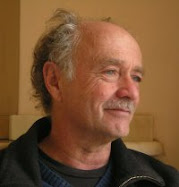
In honor of (yesterday's) St. Patrick's Day, I want to lift a jar to Declan Kiberd, Irish literary scholar extraordinaire. Kiberd is the author of definitive books on Irish literature, including Synge and the Irish Language, Men and Feminism, Inventing Ireland, Irish Classics and The Irish Writer and the World. (He's also annotated and written the introduction to the Modern Classics edition of James Joyce's Ulysses.) He has all the drama, pathos, contestatory intrigues, and language-in-several-languages of nearly every Irish writer in his head, and can recite text and verse from hundreds of sources, in the grand Celtic story-telling tradition. He's a meticulous, respectful critic, able to locate writers in their historical moment and its aftermath. Beyond that (as it says on the Declan Kiberd Appreciation Society facebook page) he's an "all-round solid man." (I know he would get a chuckle out of that – if he read facebook!)

I first met Declan in the summer of 1984, when I attended the Yeats International Summer School in Sligo. I arrived there after a 6-week International Semiotic and Structural Studies Institute Summer School in Toronto (that's another story), listening to lectures by thinkers as diverse as Howard Gardner, Paul Ricouer, Fred Jameson, and Jacques Derrida. Suddenly I was in Sligo, staying at a modest b&b near the sea (the only guest of an elderly couple), sitting alone at an opening lecture on the topic of "Anglo-Irish Attitudes" (later to become an influential Field Day pamphlet). Declan Kiberd was on stage, speaking at a podium with such passion and fervor that he simply released his notes to the floor when finished with a page – they floated down around him, to be gathered up at the end to the sound of resounding applause.

I looked to my left to say something in amazement to the small red-haired woman who happened to sit beside me; she giggled and said "Oh yes, he's my brother, he can get very worked up on the topic! He's mad, quite mad!" We stole Declan away afterwards for a quiet fish and chips lunch, where I learned that his 2nd daughter, Amy, had just recently been born in Dublin; he was missing his wife Beth, daughter Lucy, and the baby. He warned me to "Pace yourself!" during the Yeats Summer School, which does, indeed, become very intense. (Imagine a seminar with poetry critic Helen Vendler, followed by drinks at a crowded pub, and then céilidh dancing and ballad singing, with Seamus Heaney in company, at the St. Columbanus Club into the wee hours: it was amazing good craic!)

We became friends and there is much more to say, except that it's been far too long since I've seen the Kiberds. The entire Kiberd family is remarkable, and when I taught in Ireland in 1987, Declan's parents, sister Marguerite, and brother Damien were the anchors of my experience. (Declan, Beth and the girls were in Santa Barbara that year, alas, importing Irish literature to the land of sports cars and surf boards.)

No email for Declan Kiberd, something I do find appropriate, for some reason. I can see his distinctive handwriting in green ink on long yellow ledger papers, swiftly preparing book after book. With love and admiration in the aftermath of St. Patrick's Day, I want to join all of the others in the Declan Kiberd Appreciation Society (electronic and no) whose lives and minds have been touched by the brilliance, kindness, humor, and passionate generosity of this exceptional man. Here's a shout!